
Vocabulary Building Kit
 Rooted in Neurodevelopment
 High quality materials
 Eco-Happy
 Fun & Engaging Activities
Common Core
Vocabulary, sorting, and matching cards are hands-on, playful ways of building a child's vocabulary before formal reading instruction begins.
The Vocabulary Building Kit is a Montessori system for ages 3–5 that develops vocabulary and verbal reasoning — two of the beginning strands of Scarborough's Reading Rope (Scarborough, 2001) on the Language Comprehension side of the Simple View of Reading (Gough & Tunmer, 1986). It's the vocabulary component of the Literacy Foundations Kit, drawn out as a standalone starting point for children who aren't yet ready for letter-sound work. Comes with a clear, easy-to-use lesson plan booklet.
What's Included:
-
Teacher Curriculum/Lesson Plans — step-by-step guidance for implementation.
-
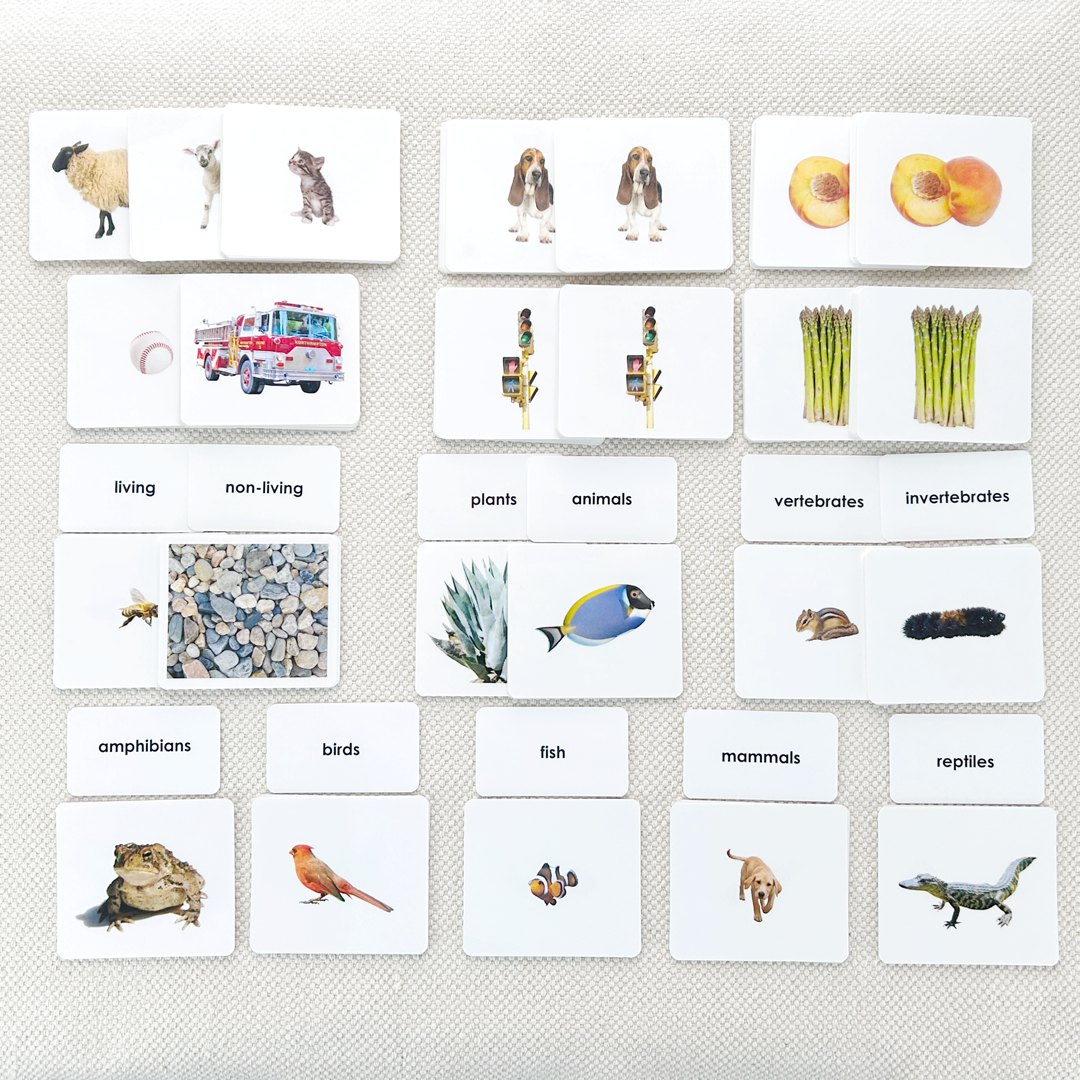
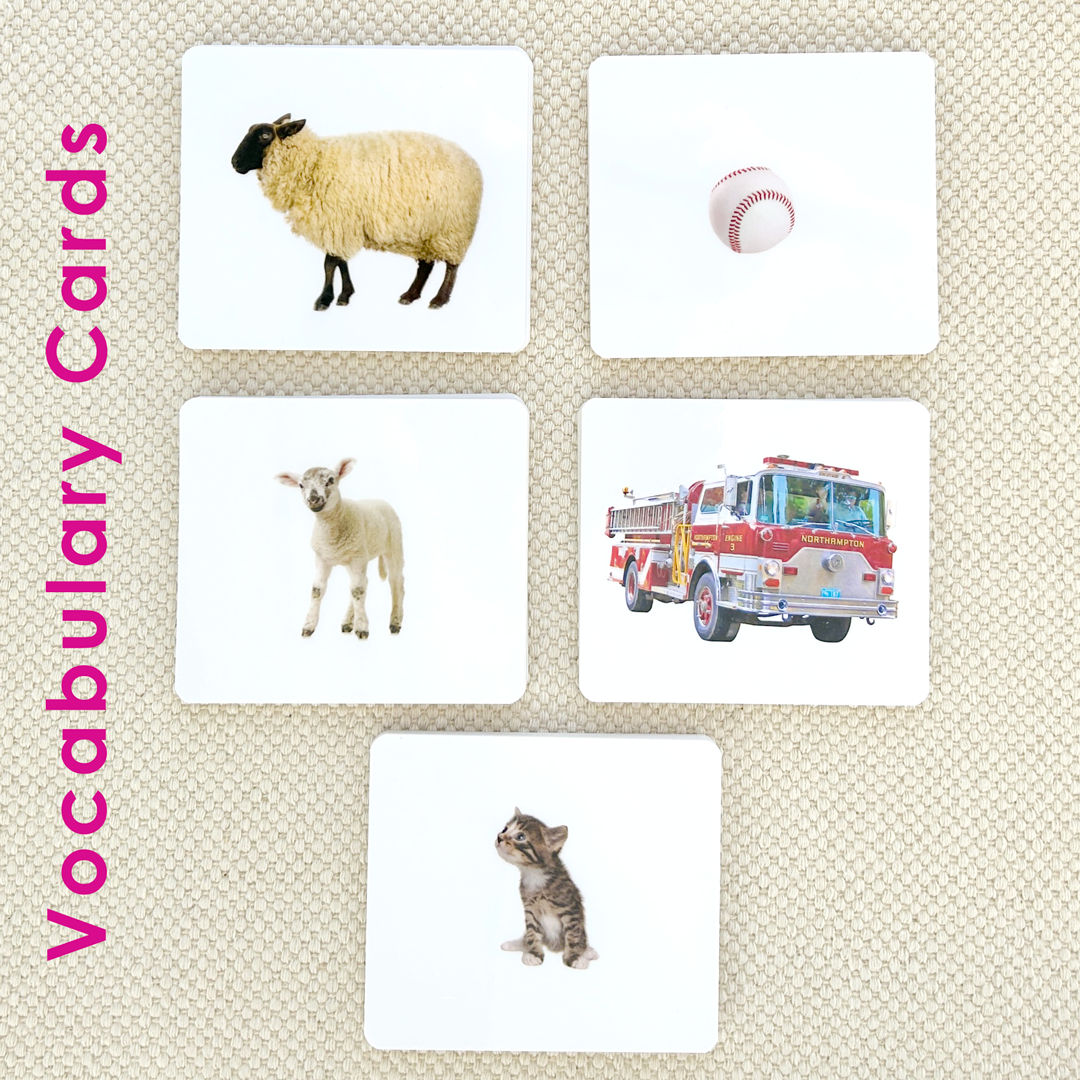
Vocabulary Cards (5 packets) — Farm Animals (Adult), Farm Animals (Juvenile), Pets, Sports Equipment, Transportation.
-
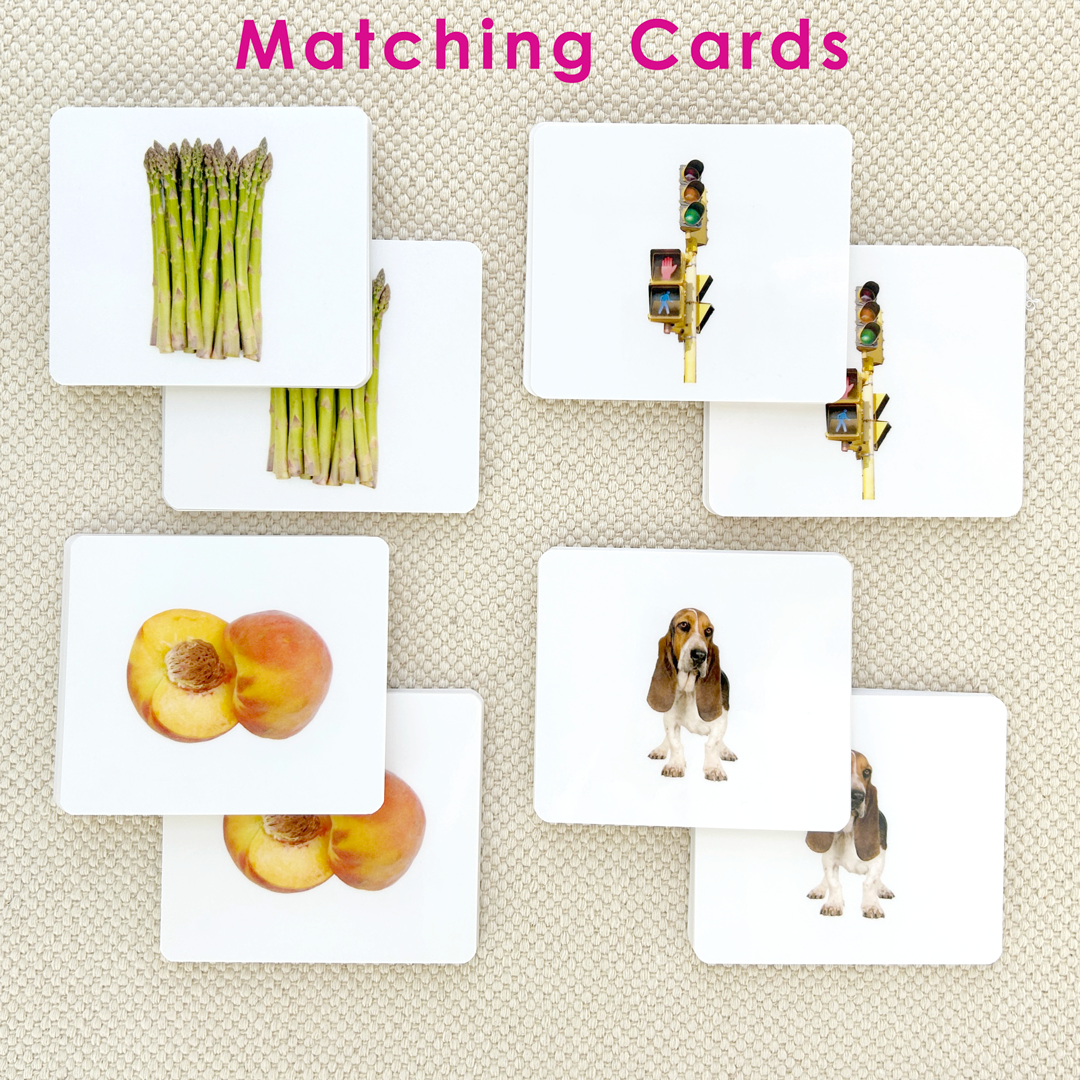
Matching Cards (4 packets) — Fruit, Vegetables, Around Town, Dogs. Use these first for vocabulary building, then for matching and sorting practice.
-
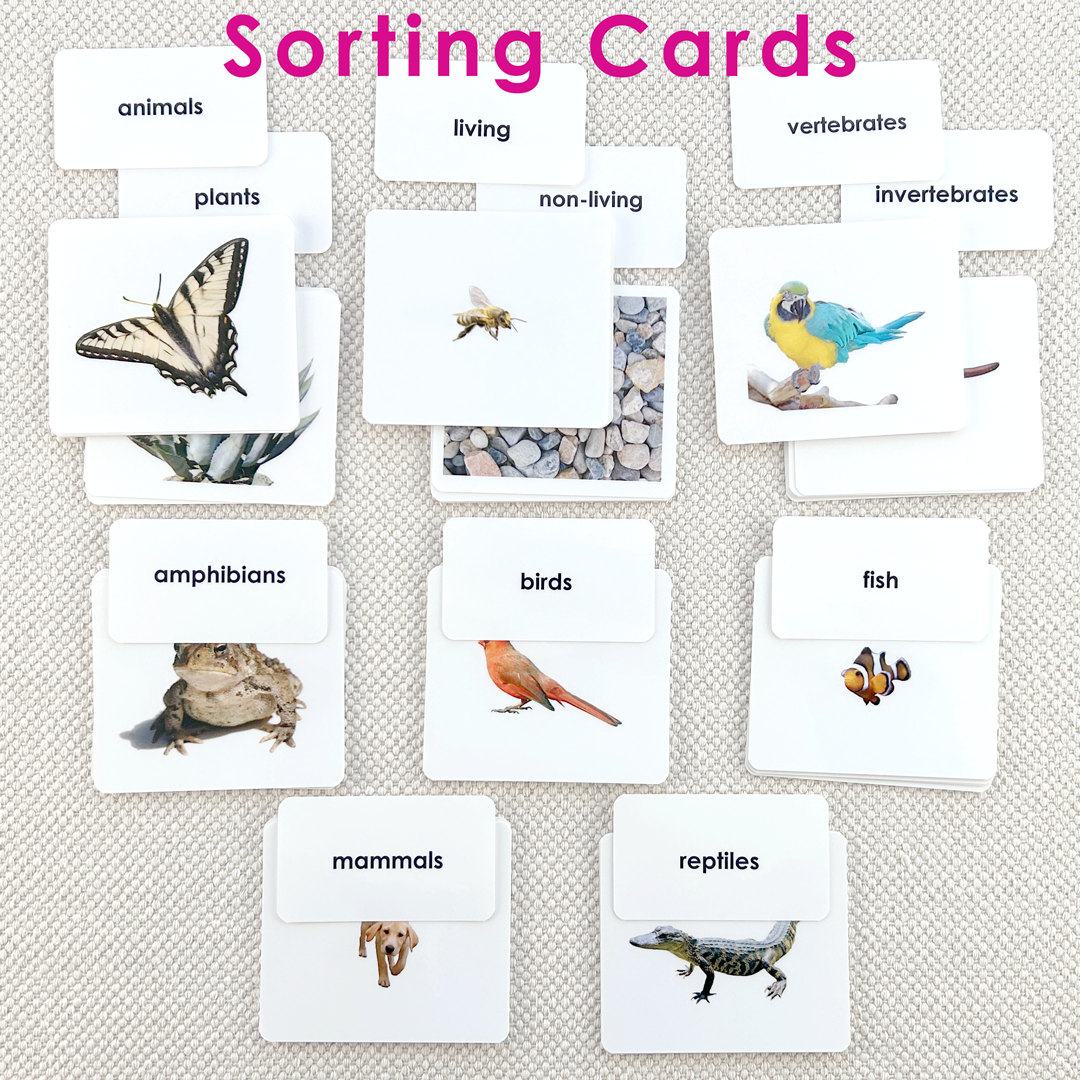
Sorting Cards (4 packets) — Living/Non-living, Plant/Animal, Vertebrate/Invertebrate, Vertebrate Classes/5.
We recommend having one or two topics out at a time and rotating packets every week or two, so the same type of material stays fresh and engaging throughout the year.
All cards are eco-made in the USA, are laminated with a food-grade laminate, have rounded corners, and are ready to use right out of the box. CPSIA compliant.
Add-on Cloth Pouches
-
Add-on three cloth pouches to make things beautiful to display and easy to organize:
- Two medium one-pocket pouches for vocabulary and sorting cards (lemon and orange).
- One two-pocket pouch for matching cards (chartreuse green).
How the kit builds literacy skills:
Vocabulary is one of the foundational strands of Language Comprehension in Scarborough's Reading Rope (Scarborough, 2001) — the side of the rope that, alongside Word Recognition, combines to produce skilled reading (Gough & Tunmer, 1986). Before children can comprehend what they read, they need a rich store of words and concepts to draw on. This kit builds that store in three connected steps.
Step 1: Build Vocabulary
Vocabulary Cards introduce new words tied to concrete, familiar topics — farm animals, pets, sports equipment, transportation. Children learn each word through hands-on exploration and repetition, following the Montessori three-period lesson.
Step 2: Practice and Reinforce
Matching Cards let children apply new vocabulary in a simple, self-correcting game: pairing identical images to reinforce word-object association. This step also builds visual discrimination and sustained attention, both of which support later reading tasks.
Step 3: Organize and Classify
Sorting Cards move children from naming individual words to grouping them by shared concepts — living/non-living, plant/animal, vertebrate/invertebrate. This is an early form of verbal reasoning, another strand of Language Comprehension, since sorting requires children to identify relationships between words rather than just recall them.
Together, these three steps take a child from learning a word, to using it, to reasoning about how it connects to other words — building the vocabulary and verbal reasoning foundation that later supports reading comprehension once decoding skills are in place.
What is the Science of Reading?
The Science of Reading is the interdisciplinary body of research — from cognitive psychology, linguistics, and neuroscience — explaining how children learn to read. It identifies two foundational components of skilled reading: language comprehension (understanding language) and word recognition (decoding), which lead towards reading comprehension (Gough & Tunmer, 1986).
What is Scarborough's Reading Rope?
Scarborough's Reading Rope is a model depicting skilled reading as several strands — including vocabulary, phonological awareness, and decoding — that weave together as a child develops literacy (Scarborough, 2001). The Vocabulary Building Kit targets strands from the Language Comprehension side of the rope.
What ages is this kit designed for?
Ages 3–6. This range aligns with Montessori's sensitive period for language, when children are especially receptive to vocabulary acquisition.
How is this kit Montessori-aligned?
These materials are found in most Montessori language albums; they use hands-on cards that isolate one skill at a time, allow independent or small group work, and follow the concrete-to-abstract sequence Montessori education is built on.
Product Details
Choose options
Included In This Bundle


Favorites/4
Knowledge Bank
Recommended Articles
Download a PDF of our materials

Follow Us