Vocabulary, Background Knowledge, and Connection: How Montessori Builds Language Comprehension
How does Montessori build the Language Comprehension Strand of Scarborough's Reading Rope?
I had an insightful Zoom call today with Susan Zoll, PhD, an early childhood education researcher and co-author of Powerful Literacy in the Montessori Classroom, to look at how Montessori builds the language comprehension strand of Scarborough's reading rope (Scarborough, 2001). The answer is, we do it explicitly (via vocabulary cards, matching cards, sorting cards, geography folders, fine art cards, and more) but also by building relationships and taking the child's interests as our starting point.
This, of course, is rooted in neuroscience. Research by Mary Helen Immordino-Yang and colleagues shows that when we have supportive emotional environments, it makes it easier to learn (Immordino-Yang et al., 2023). So we always begin by finding a way to connect with and empower each child.
Once we have a connection, we can tackle the Language Comprehension (Understanding Language) strand of Scarborough's Reading Rope. Today, Dr. Zoll and I spoke about three aspects of the language comprehension (understanding language) strand of the reading rope: vocabulary, background knowledge, and verbal reasoning.

How does Montessori build vocabulary?
As we build our relationship with each child, we discover what they are interested in. Then we link that to the classroom materials. If they love dogs, we pull out the dog breed cards. If they love trucks, we get the transportation cards. We show them that school is important for them; it teaches things they want to know.
Now what if all they care about is Peppa Pig? No problem. We connect that to the farm and link them to the vegetables cards or the farm animals cards. Even if we don't approve of their interests, we can find a way to connect them to something skillful and help them develop meaningful fields of inquiry.
While we're doing this, we're also explicitly teaching them the names of every object and living thing in the classroom. We use Séguin's 3-period lesson to do this.
Once they can recognize new vocabulary terms (if you say show me the Basset Hound, they point to the Basset Hound card), they need a chance to practice working with it. It's this repetition that is key for laying down strong neural pathways (see my TEDx talk for details). Matching cards are a great way to encourage repetition.

How does Montessori build verbal reasoning?
Sorting, classifying, and categorizing pictures helps with the development of gist (see references below) and verbal reasoning. The point of these activities is to help children 'infer' what's going on/how things are connected. Sometimes we guide children to sort in specific ways (like sorting clothing from vegetables). Other times, the children will sort things using their own logic (maybe by size or color or even likability). The way the sorting is done is less important than the fact that they are learning how things fit or don't fit together. It's one of the earliest steps in learning to arrive at or deduce a conclusion.
How does Montessori build background knowledge?
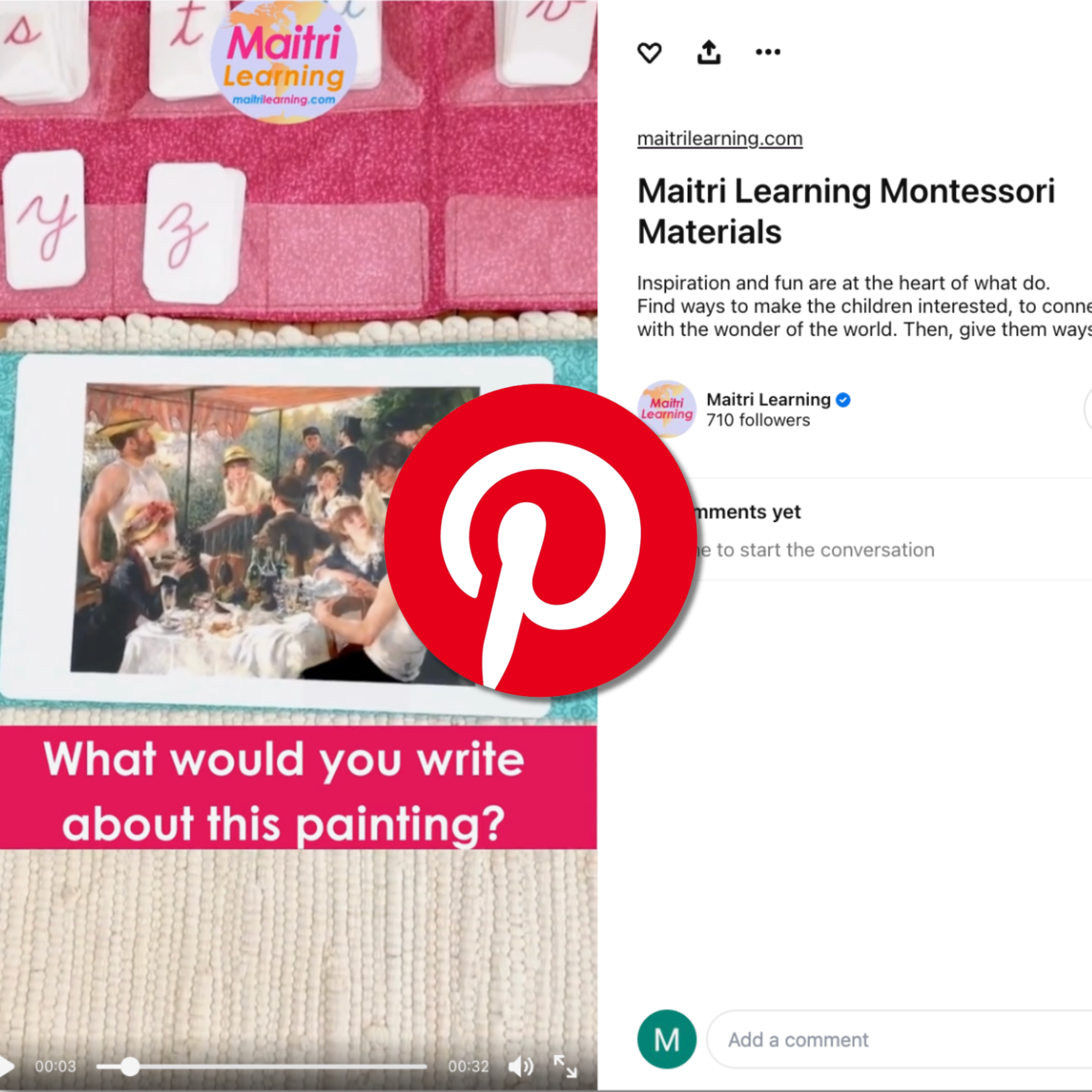
Montessori explicitly develops background knowledge through learning materials like geography folders, fine art cards, and books. We implicitly build it through our conversations, choices of music, decorations, art activities, celebrations, and more. The key thing here is to help children become curious about different topics.
Fine art is a classic way to do this. Discussing art gives children opportunities to express themselves and say what they think about the art without the risk of being wrong.
Geography folders tie right in with these cultural studies. They let children look at beautiful pictures of people just like them who live around the globe. They can see what a market looks like in North America, in Asia, in Africa, and even in Antarctica (where they stock a lot of candy at the research station). These materials are bursting with jumping off points into different areas of study.
Where can I get Montessori Early Literacy Materials?
Skim over all of our Classroom Kits but you may wish to begin with the Maitri Learning Vocabulary and Background Knowledge bundles.


We'll post a link to Dr. Zoll's recording of our chat once it's available. In the meanwhile, follow your interests and share your spark and curiosity with your students.
References
Immordino-Yang, M. H., Nasir, N. I. S., Cantor, P., & Yoshikawa, H. (2023). Weaving a colorful cloth: Centering education on humans’ emergent developmental potentials. Review of Research in Education, 47(1), 1-45.
Scarborough, H. S. (2001). Connecting early language and literacy to later reading (dis)abilities: Evidence, theory, and practice. In S. Neuman & D. Dickinson (Eds.), Handbook of early literacy research (Vol. 1, pp. 97–110). Guilford Press.
How categorization/sorting activities (e.g., with sorting cards or vocabulary cards) help support verbal reasoning and/or gist.
-
Cain, K., & Oakhill, J. V. (1999). Inference making ability and its relation to comprehension failure in young children. Reading and Writing, 11(6), 489–503. https://doi.org/10.1023/A:1008084120205
-
Ferguson, B., Havy, M., & Waxman, S. R. (2015). The precision of 12-month-old infants' link between language and categorization predicts vocabulary size at 12 and 18 months. Frontiers in Psychology, 6, Article 1319. https://doi.org/10.3389/fpsyg.2015.01319
-
Fisher, A. V., Godwin, K. E., Matlen, B. J., & Unger, L. (2015). Development of category-based induction and semantic knowledge. Child Development, 86(1), 48–62. https://doi.org/10.1111/cdev.12277
-
Nation, K., & Snowling, M. J. (1999). Developmental differences in sensitivity to semantic relations among good and poor comprehenders: Evidence from semantic priming. Cognition, 70(1), B1–B13. https://doi.org/10.1016/S0010-0277(99)00004-9
-
Weekes, B. S., Hamilton, S., Oakhill, J. V., & Holliday, R. E. (2008). False recollection in children with reading comprehension difficulties. Cognition, 106(1), 222–233. https://doi.org/10.1016/j.cognition.2007.01.005




2 comments
Thanks Christine! I couldn’t agree more. We don’t want a rich love of the world and all it has to offer to be lost in phonics drills. Phonics and vocabulary/content knowledge go hand in hand. I think your students are super lucky to get to learn from you!
Julia Volkman
These are exactly the skills I explicitly teach in my Montessori-based Structured Literacy course. Yes, our environments and materials contribute so much- but comprehension instruction is lacking too often in the specifics. Vocabulary and background knowledge of course, but teachers need the knowledge to share with their students. It’s the details that matter. AND I always recommend the materials from Maitri as an important part of every language area.
Christine Lowry
Leave a comment
This site is protected by hCaptcha and the hCaptcha Privacy Policy and Terms of Service apply.