Language Development: The Big Picture
In short: Children learn to speak by being around language. Reading and writing have to be taught. Montessori teaches them in eight steps, each one building on the last.
Here's the complete Montessori language progression, from spoken language through reading comprehension.
As long as a child is exposed to some language in their early life, they will almost always learn to speak. We can do much to enrich these offerings, to give the child a greater wealth of words at their command, but we cannot make them learn to speak.
But the same cannot be said for writing or reading. These, we teach.
Writing and reading require instruction and some degree of effort by the child. They must exert themselves on the components of our language to build it for themselves. Here's how each of those steps unfolds.
Step 1: Speaking & Listening
There are many ways the adult can facilitate the acquisition of verbal language, but we cannot directly teach it. Language is learned by being around other humans who speak to and with us. So, we start by preparing ourselves to have a nurturing and skillful relationship with our children. We train ourselves to offer the child rich oral language experiences. We sing, recite poems, ask questions, engage in light-hearted dialogue, and provide accurate pronunciations and vocabulary for everything we see.

This is essential, yet there is other work we do that is as important. We must adjust the child's environment, both physical and navigable (e.g., daily routines, human interactions), so that it does not in any way block the expression of the human tendencies. We trust that given the right environment, the right support structure, the child is inherently capable of developing a strong, logical, ordered, and gracious voice.
So, much of the work we do in this area occurs naturally through human relationship. There are also many explicit spoken language lessons we can offer.
But beyond what comes out of our mouths, we can profoundly influence the child's development by offering them an organized and accessible environment.
An Organized, Accessible Environment

Before we had the assistance of medical scanning or imaging devices, Dr. Montessori understood that the neural pathways in the child's brain are formed as a direct result of how the child interacts with their environment. If the child has varied and relevant opportunities to lay their hands upon their world, to exercise their will, then they forge strong and numerous neural pathways.
If they are limited in their opportunities to move, to act with meaning and intention, there will be fewer, weaker neural pathways. In both cases, the child will rely on these pathways for the rest of their life. These are the foundations upon which they rest all future learning. We must work to make sure that foundation is strong, solid, and organized. If we hope for the child to develop a voice that is logical and to express organized thought, we must provide them with surroundings that are organized. We must provide them with opportunities to exert their developing will and realize the logical consequences of those exertions.
In order to do all this, we need to prepare a space for the child that accommodates their size, abilities, interests, and timetable. Their space must give them opportunities to meet their basic needs without interference or unnecessary help. Can they reach the hook for their coat? Can they access the sink to get a drink of water or wash their hands? Is there a mirror located so that they can notice that their mouth or nose needs a wipe? Is there a spirit of open communication so that they are encouraged to engage with others? Do we move slowly and gracefully so that the child can notice exactly how we use our hands to open a lunch box or blow our nose? These tiny movements are usually overlooked by the adult, but to the child, they are diamonds. The child is intensely interested in mastering the movements that we don't even notice we make.
This point about organization and consistent routines needs to be stressed because the organization of the child's surroundings is related directly to how the mind becomes ordered or disordered. As the child begins to interact with the environment, they are organizing their intelligence. If there is disorder in the child's ability to master language, your first remedy is to remove the disorder and impediments in their surroundings.
Rich Oral Language Experiences
We also work to provide endless opportunities for the children to speak, to practice using their new language, and to hear our language in all of its stirring forms. It is through this practice, through the use and the slight adjustments the children make each time the words leave their lips, that the children work to perfect their speech, articulation, vocabulary, grammar, phrasing, and sentence structure: to perfect their verbal expression. If they are to become masters of their language, they must gain experience using it.
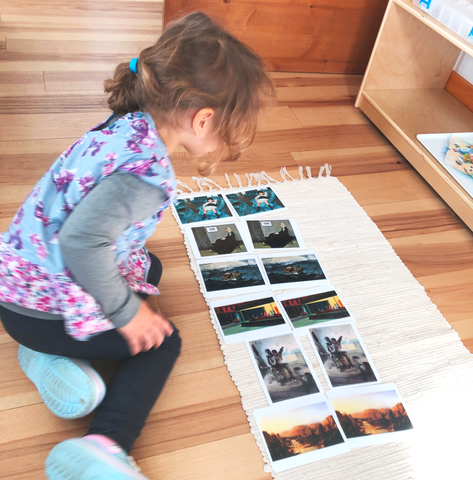
We can use fine art and geography folders to help create opportunities for them to speak while we also help them develop background knowledge on key cultural subjects. Fine art is a particularly good way to get them talking. We can ask their opinion about art, and whatever they say, they can't be wrong. It's art! (You can read more in our blog post on Art in the Classroom.)
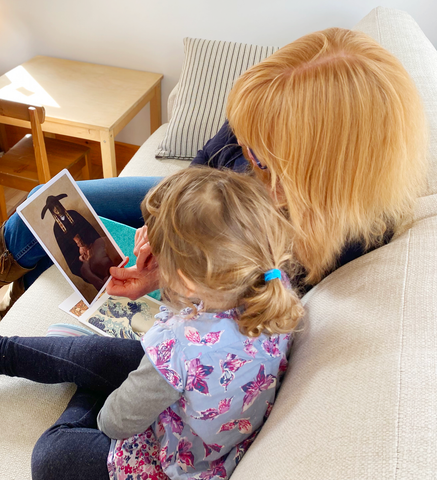
Geography folders also let us show the children the rich tapestry of culture and life around the globe. They can learn about people and customs that look similar to and different from their own. This is foundational for helping them develop an appreciation for diversity.

It is essential for a young child to have a rich internal dictionary, a store of words at their command. Many of these words are absorbed effortlessly as they go about their daily life. Words like "up" and "milk" and "hello" are examples. And yet our speech is often so quick, or the child's exposure somehow so fragmented, that it is not possible for the child to absorb everything in this manner. There are a few simple things we can do to adapt ourselves to meet the child's needs in this area:
- Repeat new words when they are introduced (e.g., this is a spoon, a spoon)
- Articulate carefully and speak slowly, at the child's pace
- Allow the child to sense your breath as you speak (i.e., the child's face or hands are near enough to your mouth that they have a tactile sensation of how much air leaves your mouth for different sounds)
- Use the 3-period lesson to teach specific terms
The 3-Period Lesson
We can use the 3-period lesson to directly teach specific vocabulary for everything in the classroom and home environment. We use real objects, photos/illustrations, and miniatures to facilitate this. For example, we walk with the 3-year-old around the classroom on her first day. We touch the sink and say, "This is the sink, sink." We touch the soap and say, "This is the soap, soap." We touch the paper towels and say, "These are the paper towels, paper towels." This first step of providing the names of each object is called Period 1.
In Period 2, we ask the child to identify the objects we name. We may say, "Can you point to the paper towels? Can you stand next to the sink? Can you find the soap?" It is during this second period that most learning takes place. This is when the child's body and mind are simultaneously engaged. So we must spend time here before moving on to Period 3.
In Period 3, we point to each object in turn and ask, "What is this?" This is the most challenging part of the lesson because the child needs to find the correct word from all of the hundreds or thousands of words she knows. This is much more difficult than pointing to the right object when the vocabulary is provided and there are limited objects from which to choose.
When thinking about this example, please note that we do not overlook any vocabulary. We do not yet know how much or how little vocabulary the children have acquired. We must give them the opportunity to succeed in the requirements of their environment. How can this happen if they don't know the names of the objects we refer to? So, we are sure to review the names of everything in their environment: hook, sink, tissue, floor, chair, etc. Often these reviews go very quickly, but from time to time we meet the child who proceeds slowly through these often overlooked basics. And it is this child we must not miss!

As we continually give them language for what's physically in their environment, we also need to offer more. We can work towards satiating their incredible desire for more and more words with vocabulary cards. We use these both to offer 3-period lessons and for sorting and matching games.
Shop Step 1: Speaking & Listening materials →
Step 2: Phonological Awareness & Encoding
The Montessori approach teaches phonetics first. Why? Because 50% of our language is phonetic. It follows predictable rules, and children love rules. They are drawn to find the logic and order within our world. The human tendencies for order and precision are very strong in the young child, and the phonetic half of English is compliant in this respect. It is systematic and predictable. There are rules that, when followed, hold the key to cracking the code of English.
We begin by teaching the child these rules. We teach them the sounds of each letter and of key phonograms. We encourage them to build phonetic words, and later, when they are ready, to read phonetic words. This process slowly builds the child's confidence. It lays out the patterns of English. It presents the rules the children love to follow and gives them opportunities to practice applying those rules: to practice hearing the sounds in words, saying the sounds of each letter, writing letters, using those letters to build words, and reading phonetic words. Then, once the child has confidence, once the child believes she can crack the code of English, we slowly reveal the non-phonetic half of English: the words that don't follow any rules at all. Wow! Words that don't follow any rules at all? That's interesting! And learning follows interest.
The Sounds of Language
Phonemic awareness begins with the child's knowledge of sounds. The child must be able to hear the sounds in words. We can help children hear individual sounds by:
- Articulating slowly and carefully
- Encouraging the children to speak and pronounce words
- Repeating new words
- Singing songs
- Reading books
- Reciting poetry
- Playing sound games like I Spy
I Spy Sound Game. This is a simple game that gives the child the opportunity (but not the requirement) to identify the sounds in words. We play it with one or several children by saying, "I spy with my little eye something in Kyra's hand that starts with the sound 'puh,' 'puh.'" Of course, Kyra is holding nothing but a pencil, so her chance of succeeding is high. Continue to sound out the word, "puh-en-sul." Do this as much as you need to until one of the children hears it and says, "Pencil!" Continue for as long as the children are interested.
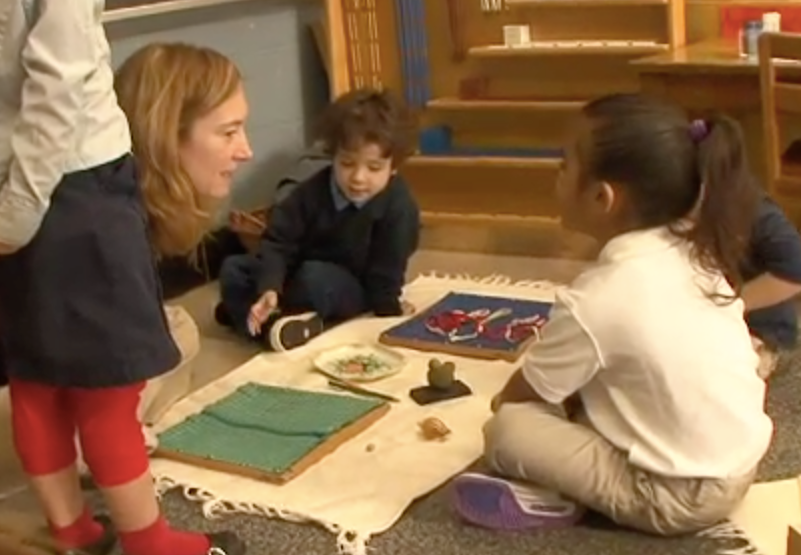
On another day, once they understand how the game works, walk about the room together and choose about six different objects, each with a different initial sound. Bring them to a workspace and play it again. "I spy with my little eye something that starts with the sound 'mmmm,' 'mmmm.'" We repeat the sound and then, unless the child beats us to it, we point to the monkey and say, "mmmm-unkey, mmmm-unkey." We repeat this for all of the objects. All the while, we are encouraging the children to play it without us, to take the lead so that they are free to work on this whenever they want to, without any help at all.
Once children master the beginning sounds in words, we move on to ending sounds and, finally, middle sounds (the hardest to hear). We do this by adding in details. For example, "I spy with my little eye something that starts with the sound mmmm and ends with the sound eeee. Monkey, that's right!" The point is to help the children hear all of the sounds in words. Once they have some success with beginning and ending sounds, add middle sounds by saying, "I'm thinking of something on the rug that starts with the sound llll and ends with the sound duh." When the child finds the lid, you continue by asking, "What other sound is in this word?" Help them hear the middle sound. Once they have success with this third level, you can ask them to notice all the sounds in longer words. Only after they succeed with this stage of sound work are they ready to take on movable alphabet work.
You can learn more about this process in our blog post on Sound Games: Teaching Phonemic Awareness.
Letters: The Symbols of Language
In Montessori classrooms, there are two primary materials used to teach children the sounds that each letter makes and how to put those letters/sounds together to create words: the sandpaper letters and the movable alphabet.
The sandpaper letters allow children to physically trace the shape of each letter while they say its sound, not its name. You can read all about that in our blog post on Developing Letter-Sound Knowledge. But, not all children are interested in tracing. For these, we offer Letter-Sound Charts. Then, we free them to practice with their new sounds using self-correcting 3-Part Letter-Sound Cards.
So it is at this stage that we adults directly teach children the sounds and symbols of our language. This is where we demonstrate that spoken language is directly linked to written language. This is where we make language concrete.
What follows is practice. Once the children can associate sound with symbol, they need opportunities and inspiration to practice using that knowledge.
Encoding: Creating Words
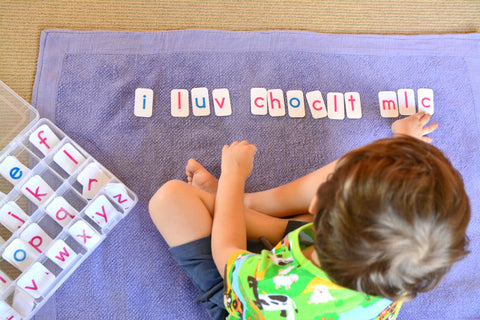
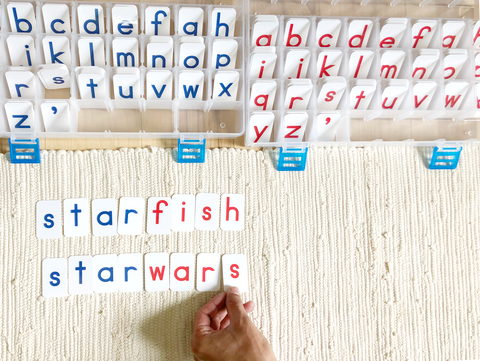
Once they know their letter sounds, they're ready to start encodign. The movable alphabet allows them to put those symbols/sounds together to create words even before their hand can hold a pencil. You can read more about this in our blog post on Phonograms Made Easy.
Traditionally, when we think of writing, we think of putting pen to paper. But there is more to it than this. Before one can have success with writing by way of the hand, one must be able to build words in the mind. This is the intellectual component of writing. It refers to the ability to put letters together to create a word. It can be done even if one has no muscular control of the hands. As such, this intellectual component of writing may develop even before the hand is able to hold a pencil (see our founder's graduate research at Harvard for evidence).
Our first work in aiding the young child to master writing is to prepare the mind for the work of writing. So what does that entail? What are the intellectual requirements for writing? In order to create words in the mind, the child needs:
- Self-confidence
- An organized mind (so they can express themselves logically)
- Knowledge of words to form complete sentences
- Phonemic awareness:
- Knowledge of sounds
- The ability to recognize sounds in words
- The ability to associate sounds with the symbols that represent them
- The ability to link letters together to make words
- The desire to write
The first four of these requirements are discussed above, with self-confidence developing as a direct result of the child's ability to witness themself succeeding in the day-to-day tasks of living.
The Desire to Write
Even once the child understands the sounds and symbols of their language, they will not progress towards language mastery unless they are internally motivated to do so. The child must have a desire to write. We can require them to complete worksheets or write assigned words, but these requirements are more likely to deter their long-term success than promote it. Instead, we must find the aspect of language that calls to each individual child. We must discover what intrigues them and let them know that they can explore that intrigue by writing about it. In short, we need to know the heart and soul of our students.

Dr. Montessori was trained as a scientist. When she considered what the children needed, she did so by observing them. She introduced different materials and observed how the children used them. She taught in specific ways and observed their response. She was meticulous in recording empirical data about the children. We must follow her leadership in this regard.
We must set aside time every day to sit still and watch. We must allow the class to unfold. We must allow the children to be free from interference (unless there is a safety concern). We must record what the children do, for how long, and with what attitude. What do they say? How do they move? What interests them? What do they repeat? In the process of these observations, we will naturally become aware of each child's present knowledge, abilities, and interests. This is the scientific form of "assessment" conducted in Montessori classrooms.
There are no written exams given to the young children. We do not quiz them or ask them to perform on command. Instead, we teach them what we can, tirelessly and joyfully give lessons on how to use the materials in the classroom, notice the magic in the world, and we watch. And when we watch, we come to learn that the children are perfect as they are. It is the environment, including ourselves, that requires fine-tuning, and once it is adjusted, the children will flourish.
When these intellectual requirements of writing are met, the children will be very interested in using tools like the movable alphabet to put into concrete form the words that come from their lips. They may come to you in the morning and want to excitedly tell you about their new shoes, and you, of course, are very interested in hearing this. But knowing that this child needs a motive to use the movable alphabet, you politely tell her, "I would love to hear more about your shoes, but I'm so busy at the moment. Maybe you could write me a note with the movable alphabet. Come and get me when it's ready for me to read."
Shop Step 2: Phonological Awareness & Encoding materials →
Step 3: Phonics & Early Reading
At some point, when the child's needs for verbal language, for phonetic awareness, and for writing have been met, there is a magical event. The child reads their first word. Just as we cannot make an infant take their first steps, this discovery is not something we as adults can make happen. It will occur on its own timetable and for reasons that will remain mysterious. We can only prepare the child to make the discovery in all the ways we have discussed. Once this preparation is complete, we continue to find exciting ways to engage them in the language work while we wait. And while we wait, we trust that they will spontaneously begin to read. This can happen as young as age 3 or as late as age 8. For most children who have been prepared as outlined here, reading begins between the ages of 4 and 6.
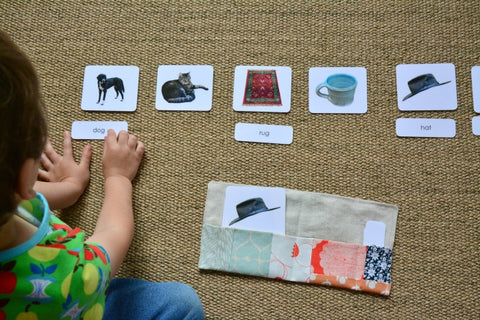
Once they read their first words, they generally don't want to stop reading! We continue to guard their growing self-confidence by giving them more and more phonetic words to read. Then we slowly branch out into phonetic words that include phonograms/digraphs.

At the same time, we introduce them to high-frequency "puzzle words." These are sight words that don't follow the rules and must be memorized (words like you, as, were, though).

Shop Step 3: Phonics & Early Reading materials →
Step 4: Reading Fluency
Once children can decode, they need lots of practice to read with ease. Fluency comes from reading many words, many times, until reading feels automatic. Then their attention is free for meaning.
We follow the pace of the child as we slowly branch out to non-phonetic words and then first-reader books. All the while, we find ways to encourage and inspire the child to write, to practice using the growing dictionary of words they can read.
Classified 3-part reading cards are ideal here. Children read a label, match it to a photo, and check their own work with the control card. Each set builds vocabulary and background knowledge at the same time.

Shop Step 4: Reading Fluency materials →
Step 5: Spelling Fluency
As they begin to read more and more, children begin to notice that English has some completely unpredictable parts to it! We help them organize what is predictable by focusing on key phonograms. We can do this with phonogram lists, spelling folders, and the phonogram dictionary.

A note on spelling: in general, we don't worry about the accuracy of spelling until around age 6. The point of early writing, of phonetically spelling words, is for the child to practice making words, to practice using the letters of our alphabet, and to practice expressing thoughts with written words. The more the child works with letters and works at creating words, the easier it becomes. As she gains confidence with this process, she slowly begins to refine her skills. Spelling is something the child will naturally refine as her language abilities grow.
Shop Step 5: Spelling Fluency materials →
Step 6: Grammar
As the child gains confidence with individual words, we slowly branch out to phrases. We use short phrases to isolate each part of speech and present it in a clear, repeatable, interesting lesson. Of course, we don't need to present a specific lesson on nouns, as most of the child's reading work thus far has dealt with nouns. We move on to the article, then the adjective, the conjunction, the preposition, the verb, and the adverb.

All of these lessons use phrases to ease the child into the more complex aspects of reading analysis. From here, we move into commands (more complex phrases) and then directly into sentence analysis.

Shop Step 6: Grammar materials →
Step 7: Word Study
From here there really is no limit. We keep going deeper and deeper, slowly adding in more complexity as we follow the child's interest. If they get excited about antonyms, we give them an antonyms activity.

If they find a contraction in something they are reading, we give them the contractions word study activity. We play a spoken language game about compound words to spark their interest in those and follow up with compound word cards and alphabet work.
Shop Step 7: Word Study materials →
Step 8: Reading Comprehension
Once their reading mechanics are in place and they have a growing inner dictionary of words they can read, our goal is to keep giving them reasons to keep reading! We want to deepen their curiosity about our language.
When they are ready for reading books, we give them books that follow up on early work we've done with vocabulary cards, read-aloud books, and 3-part cards, and we use them to introduce the definition cards.

These are fun, engaging activities that allow children to move the components of sentences around and play with sentence structure to get a sense of what works and what doesn't. These cards create grammar puzzles.
Do you see what is at the core of the work we do for language? We are always carefully observing the child to find what interests them. Then we match that interest with purposeful work.
All of this work we are doing with children as young as age 5, and we are not requiring it or assigning it. It is work that is freely chosen by the children because the work is specifically designed to call to them. It is terribly interesting! When we have laid the proper foundation, children become free to hear the voice inside them that calls out for knowledge. If our learning environments are prepared, the children can immediately and directly heed this call before it fades into a whisper.
Our intention with all of this work is to help children become masters of the spoken and written word, to realize what Dr. Montessori called Total Reading. We want children not only to be able to read and understand the words of others, but to realize their own voice, to trust in it, and to measure everything else against it. This is a much loftier goal than teaching a child to work with the mechanics of letters and phrases. This is the work of developing the child's full potential, and of realizing our own along the way.
Shop Step 8: Reading Comprehension materials →
Materials & Resources
Before presenting any material to the child, be sure to practice your presentation alone or with a friend many times. You want your presentation to be flawless, precise, consistent, repeatable, and completely free from distractions so that the child can focus on, connect with, and learn from the materials. Each lesson is like a choreographed dance whose movements you memorize. Your performance of the movements must be precise, but your interactions with an individual child will of course vary as you adapt to meet the needs of the moment. This flexibility amidst precision is the true art of guiding children.
General
- What you need for the language area
- Language Material Organization, Scope & Sequence (PDF)
- Setting Up the Language Area
- Rotating Materials: Themes, Seasons, and Magic
Step 1: Speaking & Listening
- Materials: vocabulary cards, matching cards, sorting cards, fine art cards, geography folders
- Natural Conversations
- Word Webs & Reading Circuits: Going Deep with Spoken Language Lessons
- The Motherload of Spoken Language Lessons
- Spoken Language Montessori Lessons
Step 2: Phonological Awareness & Encoding
- Materials: letter-sound materials and sandpaper letters, pink/blue movable alphabet, phonogram movable alphabet, all movable alphabets, metal insets, chalkboards
- Montessori Sound Games: Teaching Phonemic Awareness
- Independence with the Movable Alphabet
- Phonetic ABCs (MP3): the alphabet song sung with each letter's sound instead of its name. Sing it this way with your children! You can also use it as a reference for which sounds people mean when they say "phonetic."
Step 3: Phonics & Early Reading
This child has already had lessons on the phonetic object box (where the teacher handwrites the words and the child finds the object for each word). This is her first lesson using phonetic 3-part reading cards.
This child already has experience using phonetic 3-part reading cards (our levels 1 and 2). This is his first time using the phonogram 3-part reading cards (our level 3).
We begin with words that follow the rules: truly phonetic words. Then, we branch out into words that follow the rules and include the key sound phonograms (the 15 other sounds in English that cannot be written with one letter alone). Next, we move to words that don't follow the rules at all: puzzle or sight words like "the" and "one." Finally, we add in non-phonetic words that mix the rules.
- Materials: phonetic object box, phonetic 3-part cards, phonogram 3-part cards, phonetic word cards, phonetic activity cards, puzzle words
Step 4: Reading Fluency
- Materials: 3-part reading cards, zoology cards, "Parts of" cards
Step 5: Spelling Fluency
Step 6: Grammar
This is the child's first Function of Words lesson. We always start with the article, and we don't use any symbols for this first lesson. Symbols come next, when we introduce the adjective.
- Materials: Function of words/grammar cards
Step 7: Word Study
- Materials: Word study cards, word study spelling charts
Step 8: Reading Comprehension
Download a PDF of our materials

Follow Us