
Math Equation Set
 Teacher Favorite
 Rooted in Neurodevelopment
-

See the Guided Lesson Plan
 High quality materials
 Eco-Happy
 Fun & Engaging Activities
Ages/Stages
Common Core
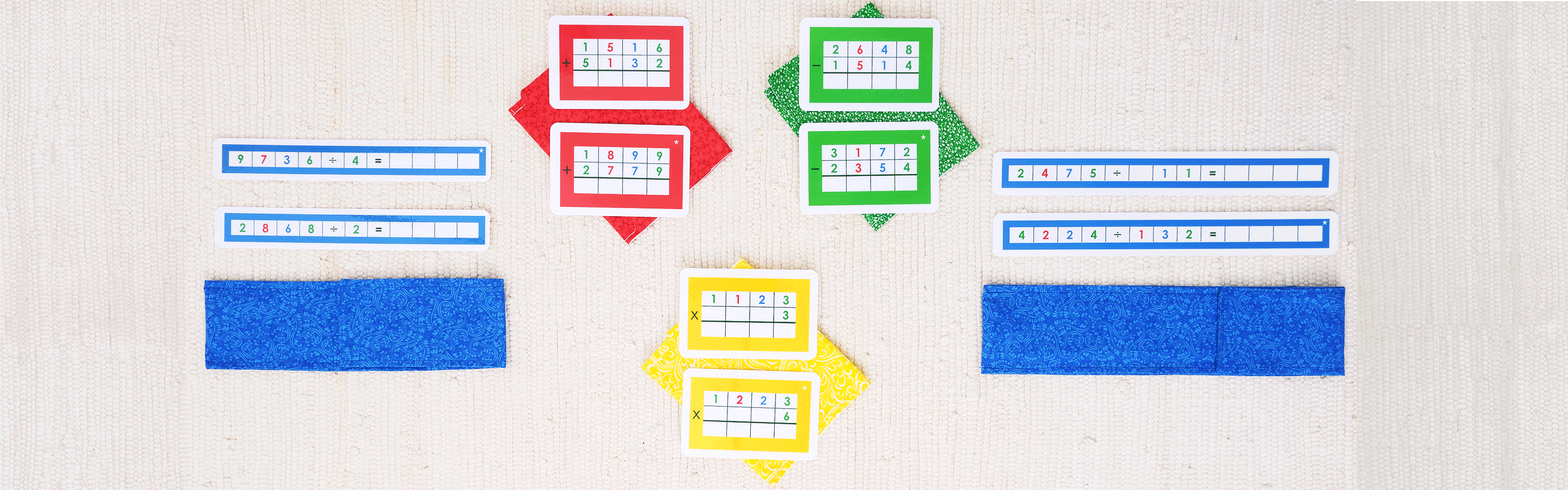
Our Montessori Math Equation Set gives students 82 prepared equations to solve independently with the stamp game, bank game, or other base ten materials. The set includes one packet each of addition, multiplication, subtraction, short division, and long division.
Every packet has both static and dynamic equations. The numerals are color-coded by place value (green for units, blue for tens, red for hundreds, and green for thousands), and each operation has its own color-coded border color. The division equations leave no remainders, so students can focus on the process.
What's included
- 82 equation cards in five packets: 41 static and 41 dynamic
- A small white star on each dynamic equation for easy reference
- Color-coded numerals
- No solutions on the cards
- Eco-laminated with a food-grade laminate and rounded corners
- A sturdy, clear reclosable bag for each packet, for teacher storage
- Black and white equation master included (or download the printable equation master)
- Lesson plan included
What's in each packet
- Addition: 16 equations (8 static, 8 dynamic) with two four-digit addends. Red border. Cards are approx. 4¼" x 2¾".
- Multiplication: 16 equations (8 static, 8 dynamic) with a four-digit multiplicand and a one-digit multiplier. Yellow border. Cards are approx. 4¼" x 2¾".
- Subtraction: 16 equations (8 static, 8 dynamic) with a four-digit minuend and subtrahend. Green border. Cards are approx. 4¼" x 2¾".
- Short Division: 14 equations (7 static, 7 dynamic) with a four-digit dividend and a one-digit divisor. Blue border. Cards are approx. 8⅓" x 1¼".
- Long Division: 20 equations (10 static, 10 dynamic) with a four-digit dividend and a two- or three-digit divisor. Blue border. Cards are approx. 10⅓" x 1¼".
Base ten materials, such as the stamp game or bank game, are not included.
Add a set of five math cloth pouches for color-coded, student-accessible classroom display: red for addition, yellow for multiplication, green for subtraction, and two blue for short and long division.
Created by a Montessori teacher. Eco-printed in our rural New England office.
Made in the USA. CPSIA compliant.
Why use prepared math equations?
Prepared equations let students work independently. A student can choose a card and start right away, without waiting for you to write a problem. Each time, they practice the same steps with the base ten materials, and they get to see what each operation really does to a quantity. Division equations are especially hard to make up on the spot, because so many combinations leave a remainder. These are ready to go, so you can stay with your student instead of working out the numbers.
How do you use math equation cards?
Once you have presented an operation, offer the matching cards so students can solve problems on their own. The cards don't show solutions, so students find each answer with their materials:
- Choose an equation card.
- Build the equation with base ten materials.
- Carry out the operation to find the answer.
- If they're writing, write the equation and answer in a math journal.
Once students have experience with dynamic equations, make photocopies of the equation master so they can create their own math problems.
What is the difference between static and dynamic equations?
Static equations can be solved without any exchanging. Dynamic equations require students to exchange, such as trading ten units for a ten when carrying or a ten for ten units when borrowing. Start with the static equations, then move on to the dynamic equations, which are marked with a small white star.
What order should students work through the packets?
Start with addition, then move on to multiplication, subtraction, short division, and long division.
What ages is this for?
Typically ages 4 to 9, once a student has been introduced to the operation with base ten materials. Students typically begin division after they have some experience with addition, multiplication, and subtraction.
Choose options
Included In This Bundle

Equations only

Without cloth pouch

Cards only

Cards only

Without Cloth Pouch
Knowledge Bank
Recommended Articles


Download a PDF of our materials

Follow Us