Fine Art Cards
"Love their subtle presence in our schooling room and the discussions these cards lead to."



 Rooted in Neurodevelopment

See the Guided Lesson Plan
 High quality materials
 Eco-Happy
 Fun & Engaging Activities
Scratch & Dent Discount: These Fine Art Display Cards did not pass our strict quality control, so you get them at a lower price. The error may be a small spot or hair under the laminate on one or more cards, color slightly different from our standard, an image printed slightly askew, or slightly curved laminate. Many teachers can't find the error, but we can! Each packet is complete, with every card included. See all of our scratch and dent materials.
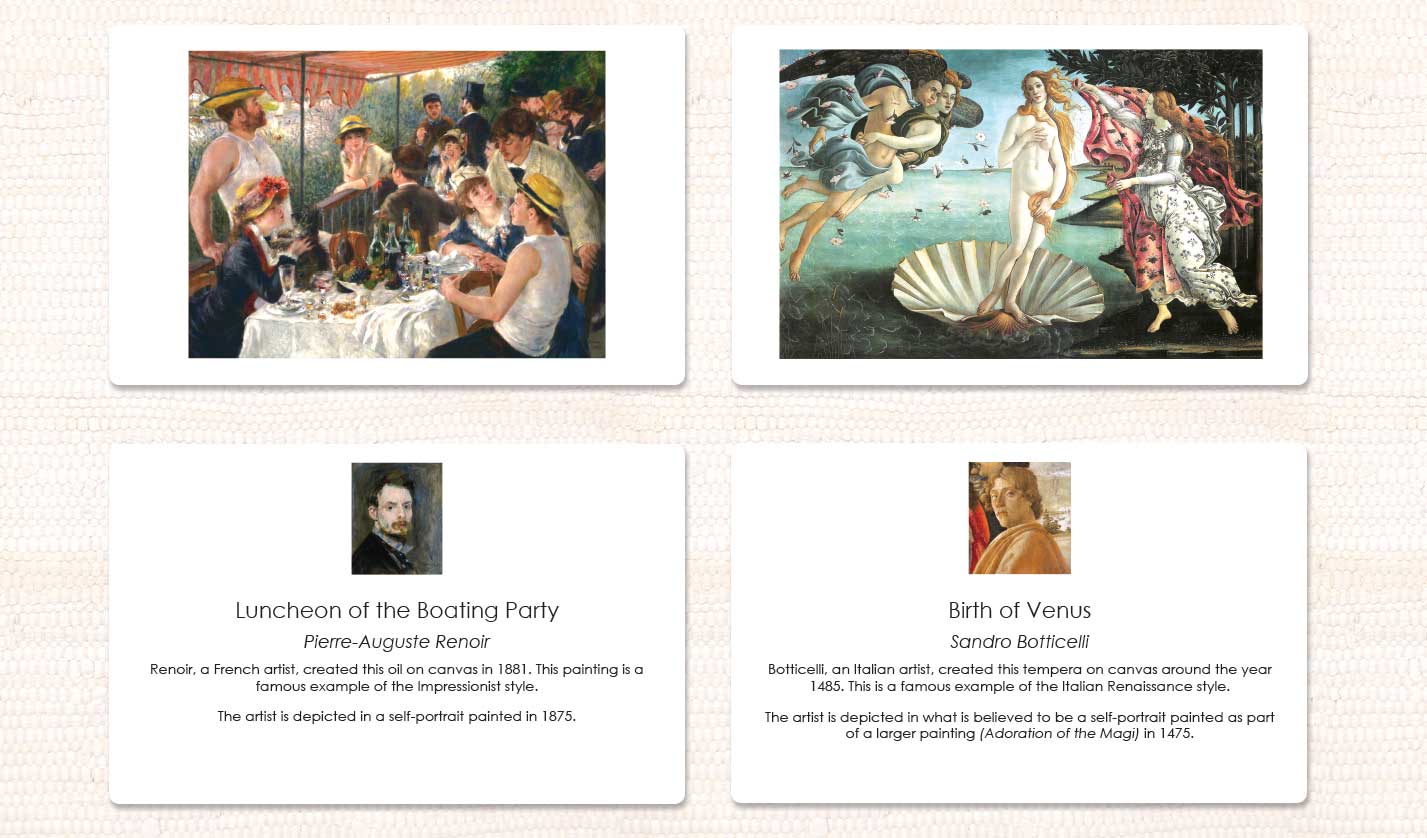
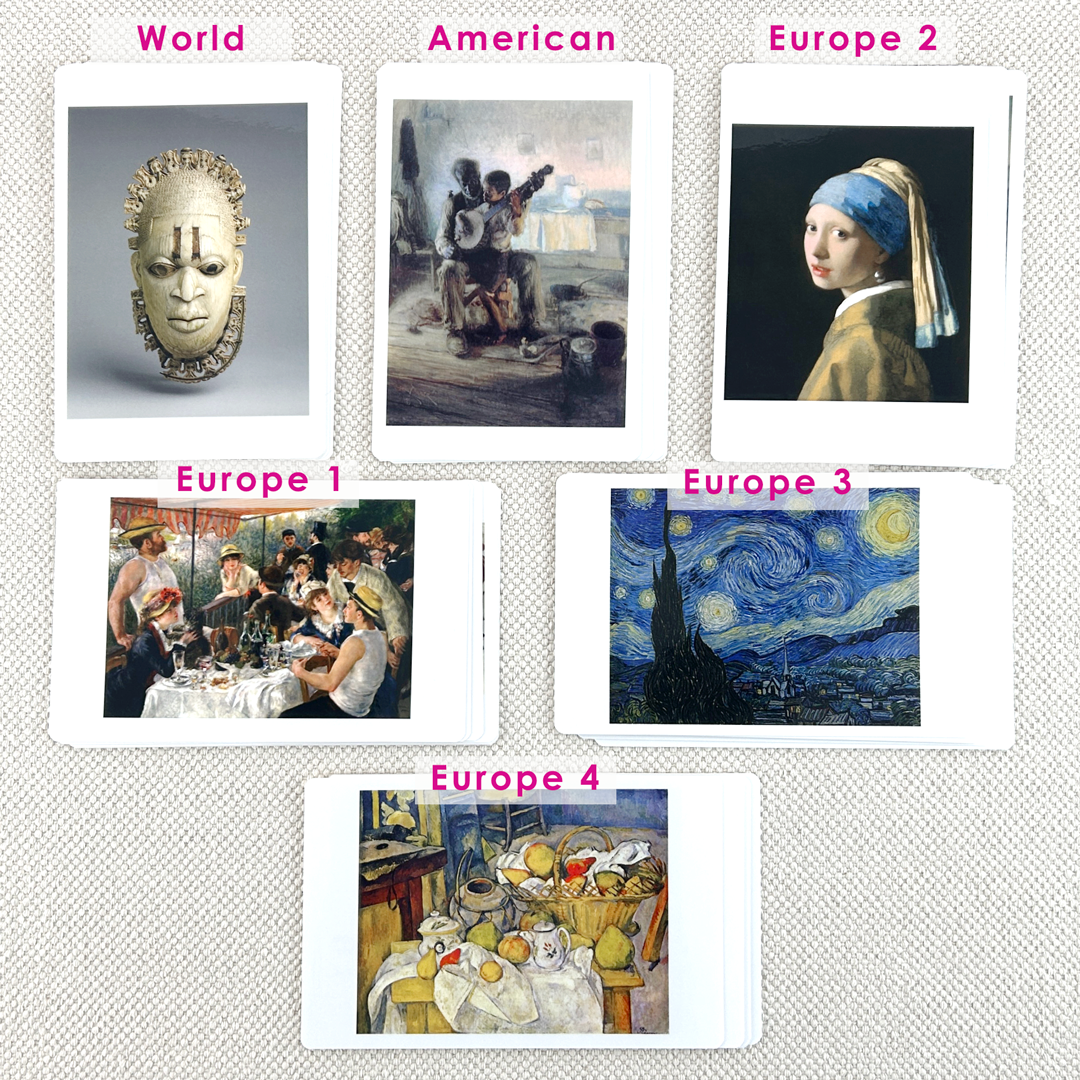
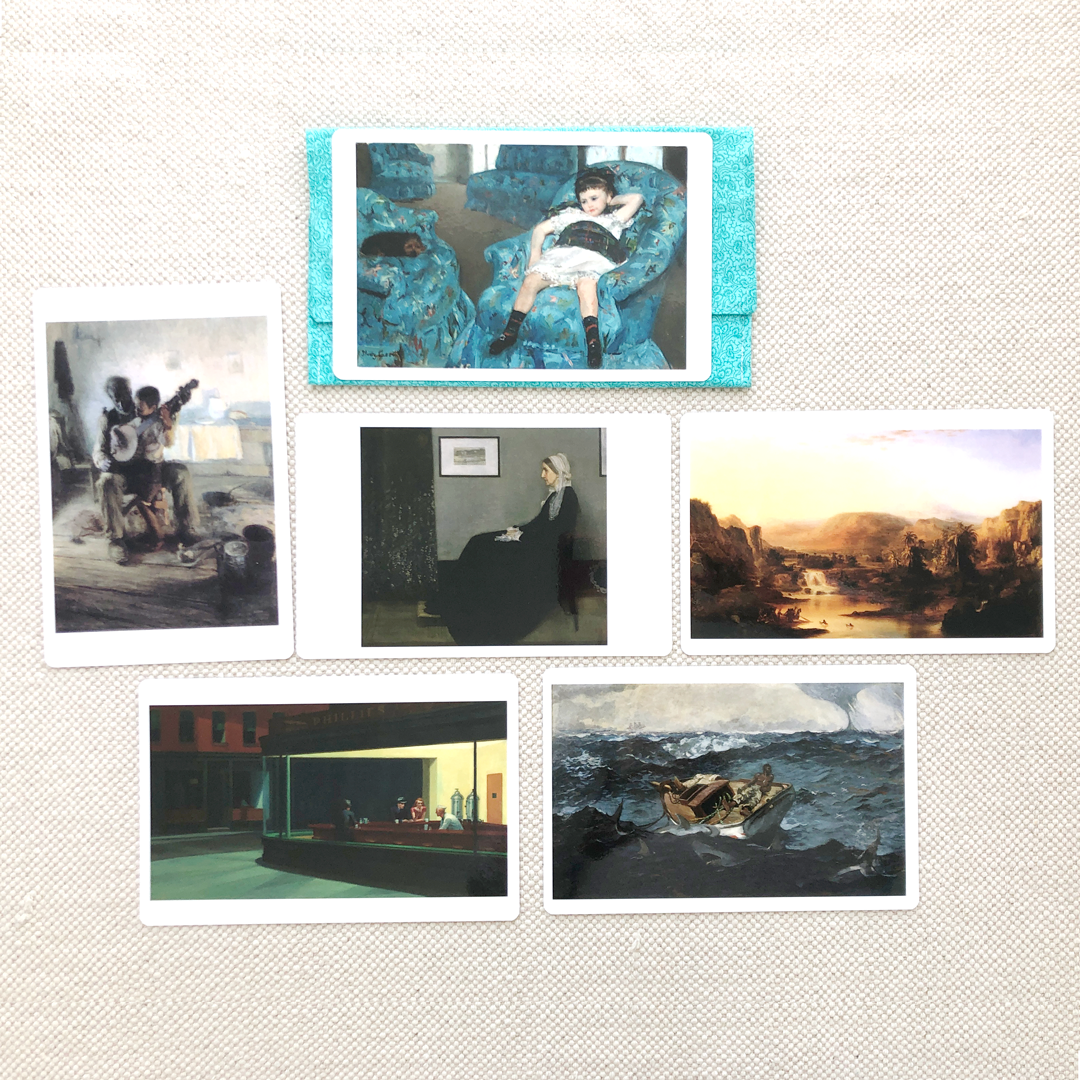
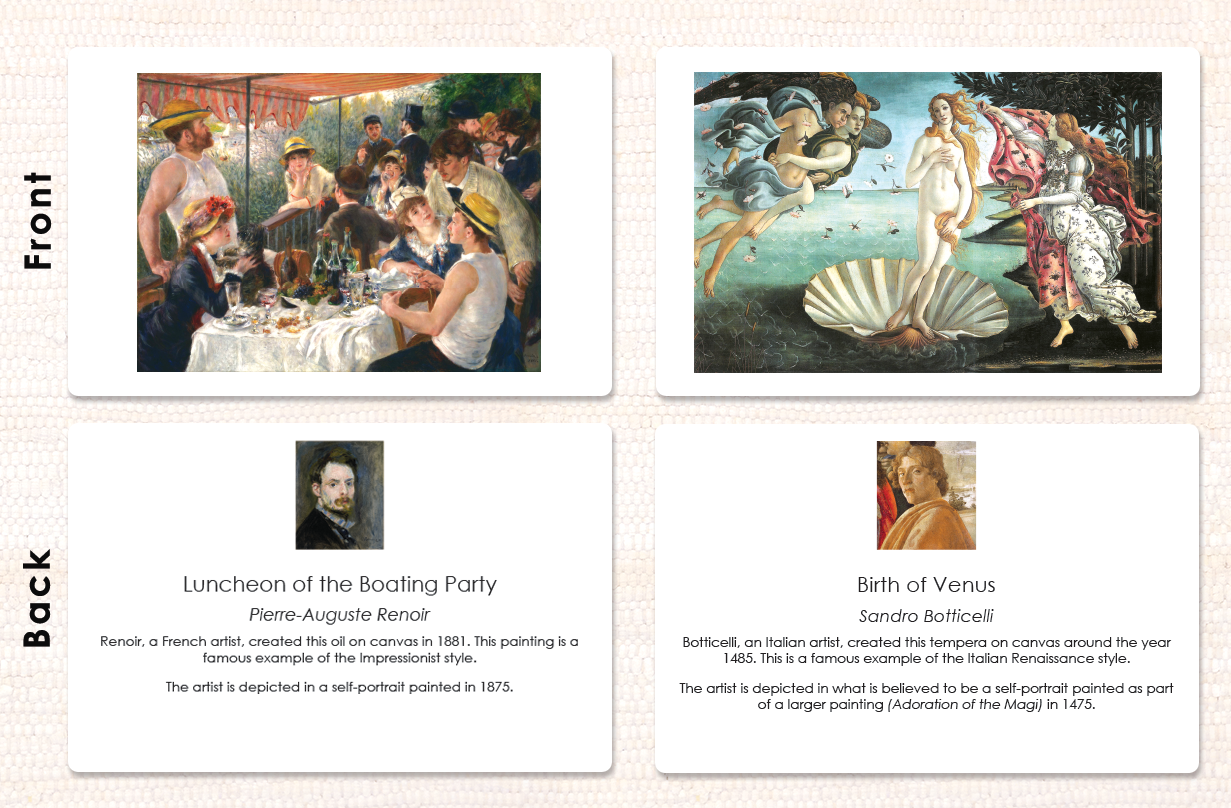
Our Fine Art Display Cards are large, laminated art cards for the fine art folders taught in Montessori training. Each series has six famous works of art. The back of each card names the artwork and the artist, shows the artist's portrait, and gives details on the year the art was created, the materials used, and the artistic style.
Use them for Conversations at a Picture, where students look at a work of art together and discuss what they see. There are no wrong answers because it's art! Students can also choose a favorite card and display it on a small easel in the room.
Add an x-large cloth pouch to display each series as a student-accessible fine art folder.
Created by a Montessori teacher. Eco-printed in our rural New England office.
Made in the USA. CPSIA compliant.
Interest drives learning, and art gives students something they want to talk about. Because there are no wrong answers, even a hesitant student can join in. Each conversation is practice organizing thoughts and saying them aloud. Along the way, students pick up new words and learn about artists, places, and times. Vocabulary and background knowledge are both part of the language comprehension strands of Scarborough's (2001) reading rope. These conversations are especially important for students who have had limited chances to speak or limited exposure to vocabulary.
For a fine art folder, put about six cards in a lovely container and take them to a work area. Take out one card at a time and ask what students see, what they like, what they don't like, what makes them curious, etc. Share your own ideas too.
In a different lesson, discuss the information on the back of each cards and conduct 3-period lessons for the name of each piece of art and, in a different lesson, the artist who made each piece of art.
For a display activity, set out six cards with six small easels (not included). Show a student how to choose a favorite, place it on an easel, and display it somewhere lovely in the room. At the end of the day, collect the art and easels so they are ready for the next morning.
You can find more ideas in our article, Art in the Classroom.
Start with the World series, which introduces art in many of its common forms. Then move to your own continent, and expand from there to the rest of the world. If you would rather skip the modest nudity in Europe 1, choose Set/5, which leaves that series out.
Not at all. You can learn about art right along with your students. Everything you need to name and introduce each work is on the back of the card. Read more about where to start with fine art.
Typically ages 3 and up, with no upper limit. Younger students enjoy looking, talking, and displaying the art. Older students can go deeper into the artists, materials, and styles. Even if you are starting with older students, begin with these cards, since they hold the essential information about each work.
Once students know the names of the artworks and artists, move on to our Fine Art Matching Cards. When students begin to write, invite them to write about a favorite work with the movable alphabet or pencil and paper. Once they are reading non-phonetic words, introduce our Fine Art 3-Part Reading Cards, then our Artists 3-Part Reading Cards. After students succeed with the Fine Art 3-Part Reading Cards, challenge them with our Fine Art 4-Part Cards.
Choose options
Knowledge Bank
Overall rating: 5.0 / 5 from 1 reviews.
Review topics: [].
"Love their subtle presence in our schooling room and the discussions these cards lead to."
Download a PDF of our materials