Spanish Land & Water 1 Book
 Rooted in Neurodevelopment
-

See the Guided Lesson Plan
 High quality materials
 Eco-Happy
 Fun & Engaging Activities
Ages/Stages
Common Core
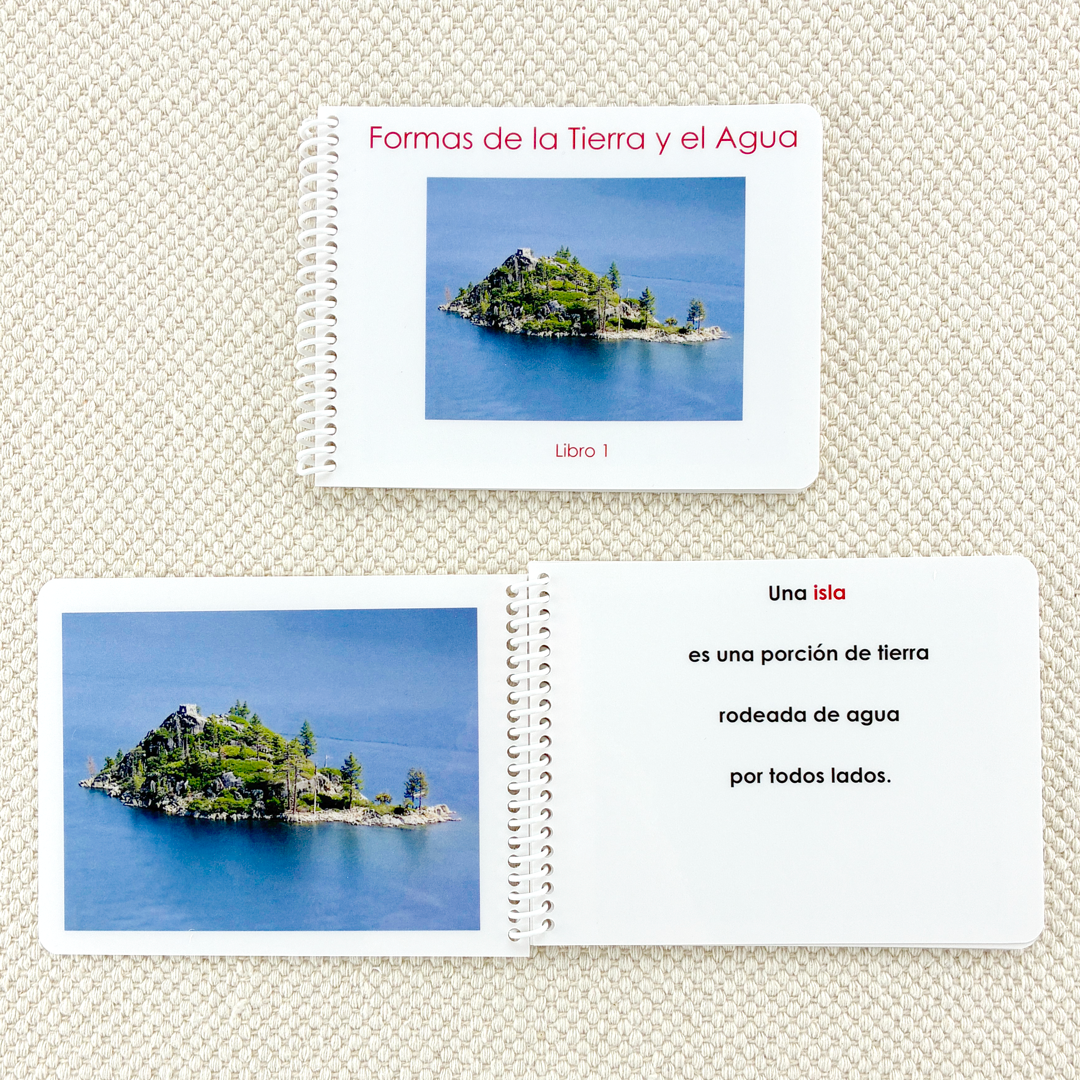
The Spanish Land & Water 1 Book is a nomenclature booklet that pairs real photographs with defined vocabulary for 10 basic land and water formations: island, lake, archipelago, system of lakes, cape, bay, peninsula, gulf, isthmus, and strait.
Each left page shows the formation in a full-color photo and each right page provides a definition with the defined term in red. This helps students move from the abstract Montessori land and water form trays to real geographical examples they'll recognize in the world.
All Spanish text was translated by native Spanish-speaking Montessorians, ensuring natural, classroom-accurate vocabulary.
What's included
- 10 fully laminated pages and covers, matched to the classic land & water form trays
- Approximate size is 4¼" x 5¼"
- Tightly spiral bound to lie flat on the workspace
- Rounded corners — no pricked fingers or dog-eared pages
- Lesson plan included
Created by a Montessori teacher; eco-printed by parents/teachers/students in our rural New England office.
Also available in Spanish and Chinese.
Made in the USA.
Note: Photos may change from those pictured.
Why does this type of book matter for literacy?
The Science of Reading identifies background knowledge and vocabulary as core strands of reading comprehension (Scarborough, 2001) — students can decode a word perfectly and still fail to understand a passage if they don't know what "isthmus" or "archipelago" actually means or looks like. Nomenclature books like this one build that background knowledge directly: a real photo paired with the printed term creates a concrete mental image for an abstract geography word, so when students meet these terms again in informational text, they're not decoding new vocabulary — they're recognizing it.
How do you use this book?
Use this book to extend a child's knowledge after they've explored a topic in the natural world or with 3-Part Cards, or to spark curiosity about something new. Set the context first — either connect to what the child already knows or entice them toward the new topic. Then read each page together, pausing to discuss as needed. For older children, engage them in analysis of the definition by asking them how they thought it would be defined? Does it sound right to them? Once they're able, invite the child to take turns reading with you, then to each other or alone.
This book also acts as a control of error for "build-a-book" or "definitions in stages" card activities.
What ages is this for?
Read this book aloud to students who are interested in the topic at any age (typically Prek-3). Invite students to read the book independently as they are able, typically grades 2 and above.
Product Details
Choose options
Download a PDF of our materials

Follow Us