

Phonogram Pre-Cursive Alphabet
 Rooted in Neurodevelopment
-

See the Guided Lesson Plan
 High quality materials
 Eco-Happy
 Fun & Engaging Activities
Ages/Stages
Common Core
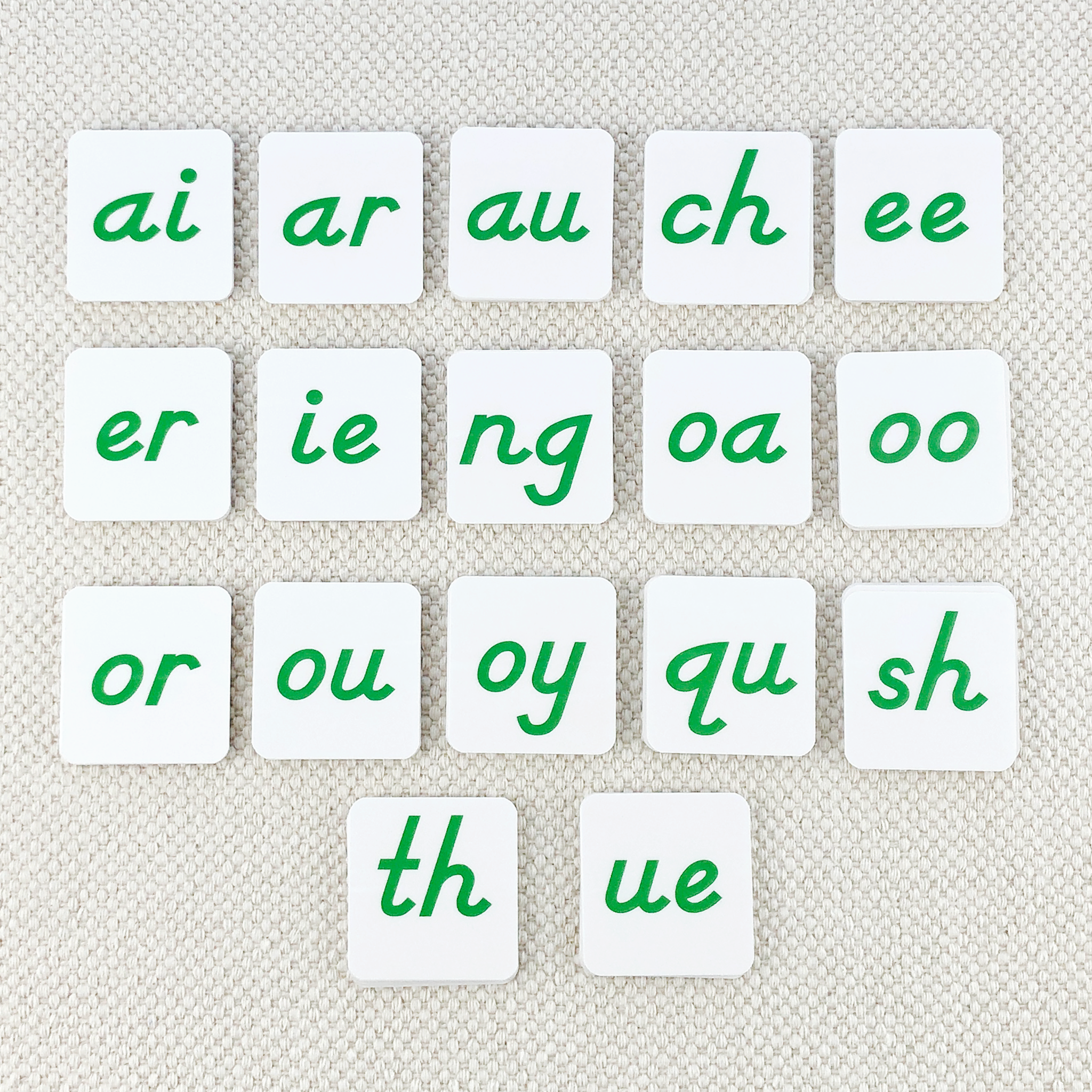
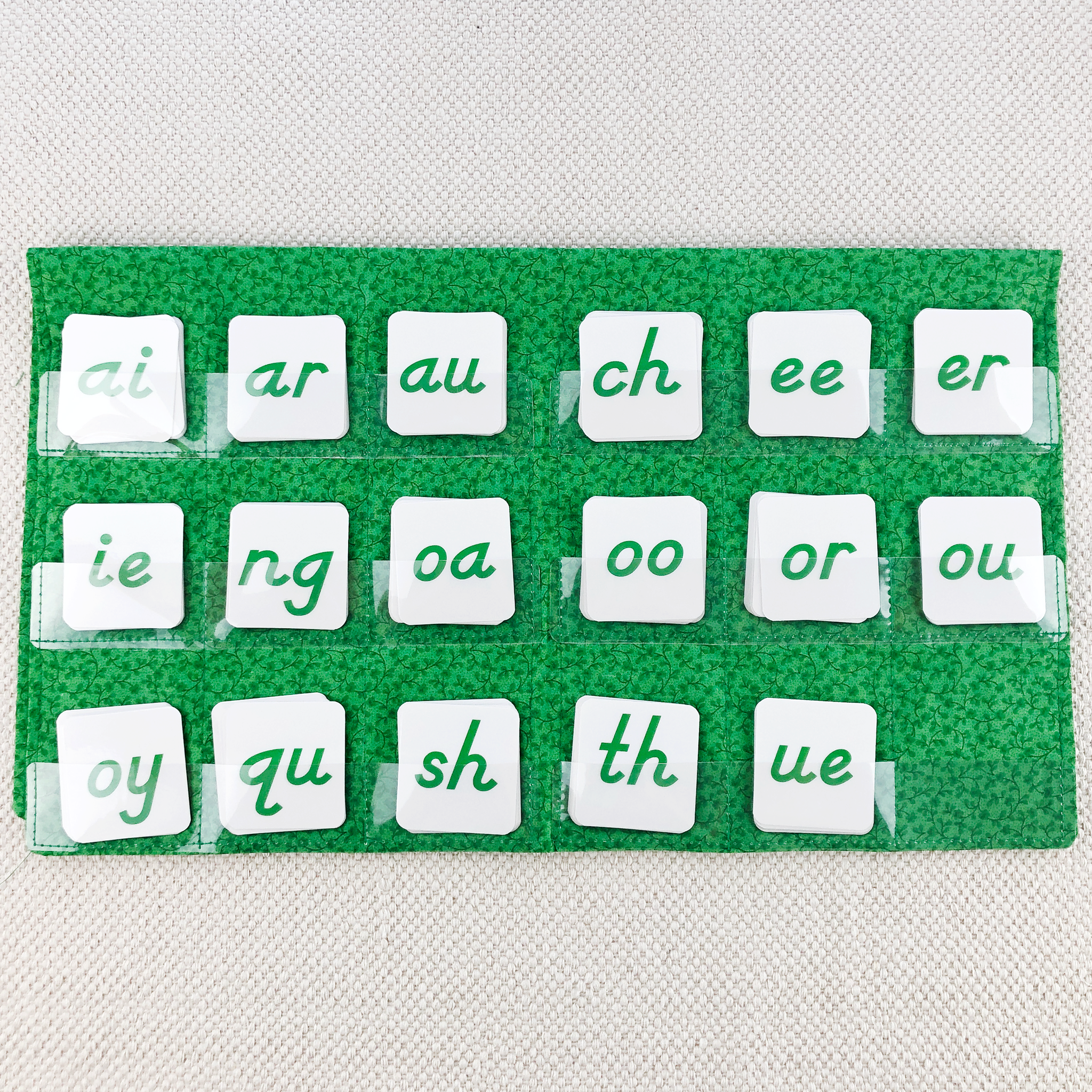
Our Phonogram Pre-Cursive (like italics or D'Naelian) Alphabet is a movable alphabet of 17 key phonograms: letter pairs that work together as a unit, like sh in ship and ee in tree. Each phonogram is printed on a single green card, so students can build words with these sounds without hunting for two separate letters. Used alongside a single-letter movable alphabet, it frees students to phonetically build almost any word and explore spelling variations.
The 17 phonograms (10 of each) that match the green sandpaper letters:
- ai as in paint, ar as in yarn, au as in Paul, ch as in chip, ee as in tree, er as in fern, ie as in pie, ng as in king, oa as in boat, oo as in book, or as in corn, ou as in cloud, oy as in boy, qu as in quick, sh as in ship, th as in moth, ue as in blue)
What's included
- 10 cards of each of the 17 phonograms (170 cards)
- Green lower-case pre-cursive on one side only, to isolate the phonogram
- Cards are approx. 2" x 2"
- Eco-laminated with a food-grade laminate and rounded corners
- Lesson plan included
| Option | What you get |
|---|---|
| Green Phonogram | The phonogram alphabet only (pair it with a single-letter alphabet you already own) |
| Phonogram + Pink/Blue | The phonogram alphabet plus our traditional pink/blue pre-cursive movable alphabet |
Add a green folding alphabet pocket chart to store, carry, and display the cards. Instructions for using the pocket chart are included.
Rather craft these yourself? Purchase a digital file and you'll be ready to print and cut your own alphabet.
Created by a Montessori teacher. Eco-printed in our rural New England office.
Made in the USA. CPSIA compliant.
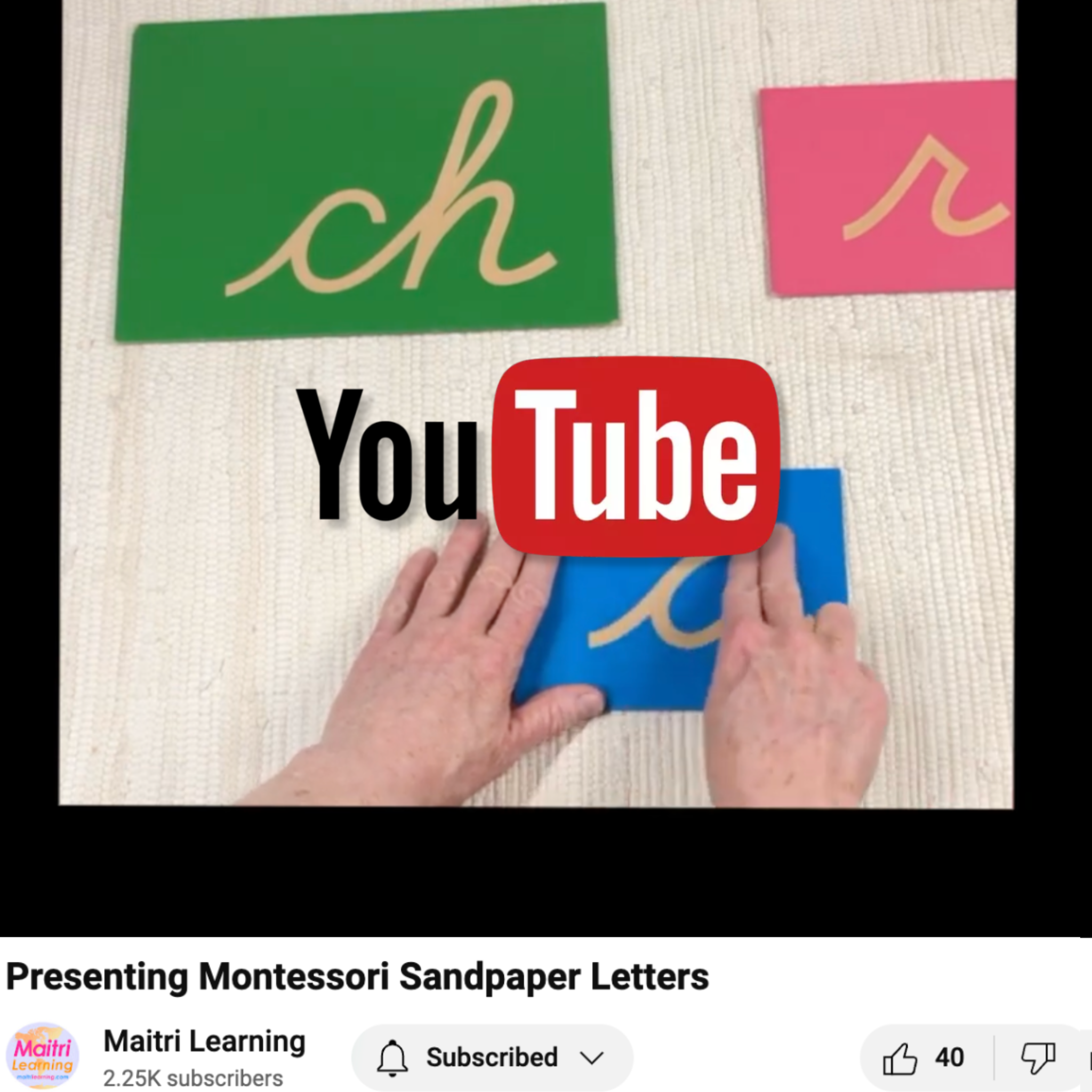
Watch a phonogram alphabet lesson
A teacher demonstrates how to present the phonogram alphabet.
Watch how the folding pocket chart works
See how the pocket chart unfolds for work, folds for storage, and keeps every card easy for students to find.
Why does a phonogram alphabet matter for reading?
Many English sounds are spelled with more than one letter. When the phonograms are printed together on one card, students can build words with these sounds as easily as with single letters, and they start to see that sh, ee, and oa are units. Building words this way (encoding) is excellent practice for later reading (decoding). Decoding is part of the word recognition side of Scarborough's (2001) reading rope.
When is a student ready for the phonogram alphabet?
Introduce the phonogram alphabet when the student can recognize (second period) most of the sandpaper letters: pink, blue, and green. Use it side by side with a single-letter movable alphabet.
How do you use the phonogram alphabet?
Whenever you start work with any movable alphabet, remember that the first lesson is how to carry the container or pocket chart, take letters out, and put them back in. Don't be afraid to practice this many times before you build a single word. If you find that students are often dropping their alphabets, revisit this lesson as often as needed. Then lay out the phonogram alphabet next to the single-letter alphabet and invite the student to build words that contain the phonograms, such as ship, rain, or boat.
What ages is this for?
Typically PreK through grade 2 (ages 3–8), whenever a student recognizes most of the sandpaper letters. It also works well for older students, English learners, and intervention.
How should I store and display the phonogram alphabet?
Our favorite way is our green folding alphabet pocket chart, which is color-coded to match the alphabet. It works like a box, so it is easy for students to carry. They unfold it at their work area and fold it again for compact storage on the shelf. The unfolded chart is approx. 18" x 20", the folded chart is approx. 9" x 10", and each pocket is approx. 2¾" x 1¾". You can also use a craft box (like the one available from the Container Store; box not included).
Choose options
Knowledge Bank
Recommended Articles


Download a PDF of our materials

Follow Us