This is what i needed for my classroom
"Nice print and quality Thank you"



 Rooted in Neurodevelopment

See the Guided Lesson Plan
 High quality materials
 Eco-Happy
 Fun & Engaging Activities
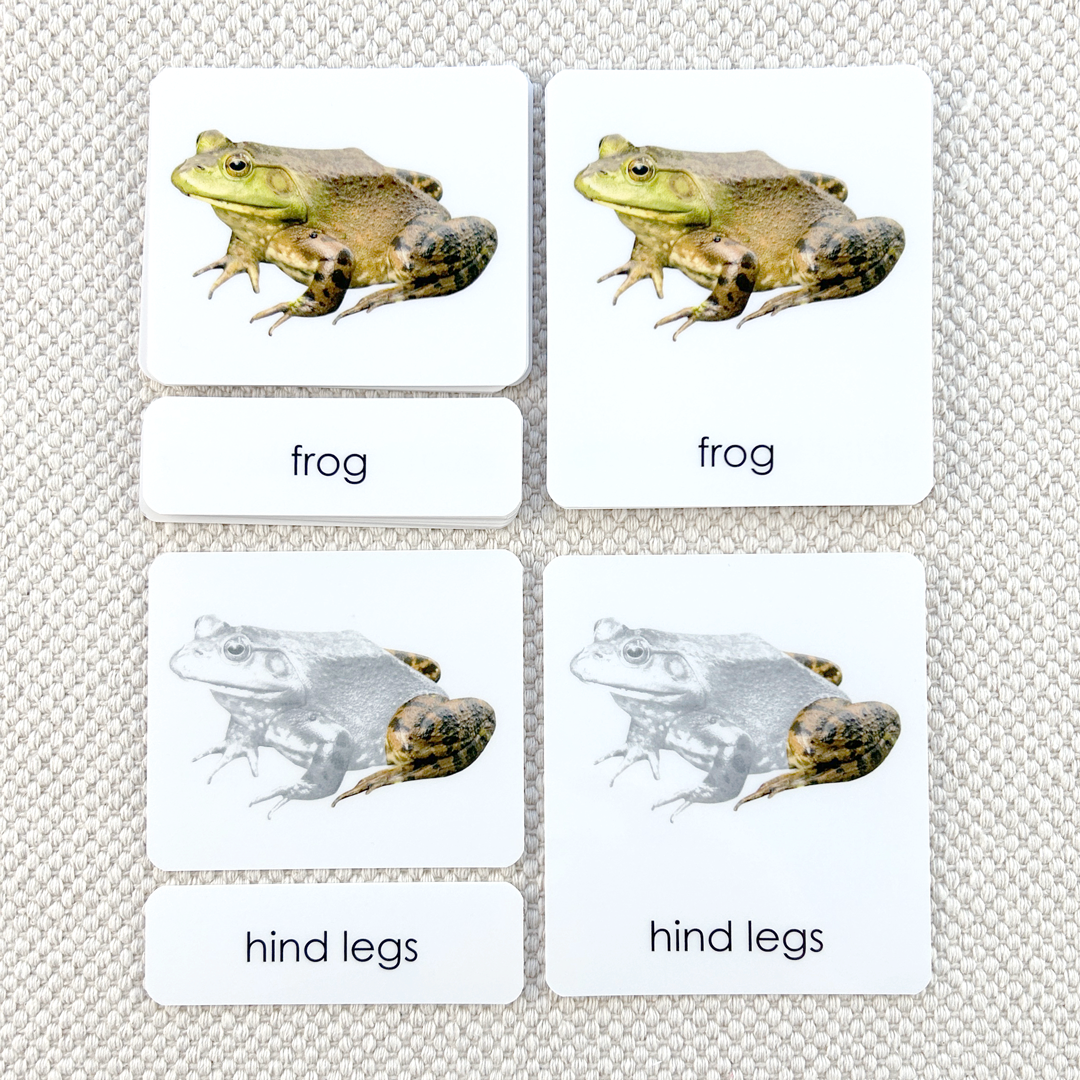
Our Parts of the Frog 3-Part Reading Cards pair real photographs of a bullfrog and its key external parts with matching word labels. Students read science words like tympanum, forelegs, and hind legs, match them to the photos, and check their own work with the control cards. This repeated, self-correcting practice builds reading fluency and connects new words to both their spelling and their meaning. Ages 5+.
A frog's tympanum is its eardrum. Frogs don't have outer ears, so the tympanum sits right on the surface as a round disk behind each eye. Frogs are amphibians, so for a look at more of the amphibian group, pair these with our Amphibians 3-Part Reading Cards.
The 3-part format is built for independent reading. Students lay out the photo cards, read and match the word labels, then use the control cards to check their work. These cards are also part of our Parts of the Frog Book & Card Set, an interactive build-a-book reading comprehension activity.
All five of our vertebrate "Parts of" packets (bird, fish, frog, horse, and turtle) isolate the same key parts of each animal, so students can lay them side by side and compare. The packets share parts like the head, eyes, nostrils, and torso, and students soon start noticing patterns. A fish's pectoral fins, a frog's forelegs, a bird's wings, and a horse's forelegs are all versions of the same front limbs, just as a fish's pelvic fins match the hind legs of a frog or horse. Other parts look different but do the same job, like a frog's tympanum and a horse's ears, which are both used for hearing. This parallel construction across species indirectly lays the groundwork for later studies of evolution. Collect all five with our Vertebrates "Parts of" 3-Part Set.
Add on our 3-pocket cloth pouches for an elegant, child-accessible display solution.
Created by a Montessori teacher and a zoologist. Eco-printed in our rural New England office.
Made in the USA. CPSIA compliant.
Note: Photos may change from those pictured.
Three-part cards make reading practice independent. The control card lets students find and fix their own errors, which is how humans learn best, with no teacher correction required. Beyond that, remember that interest drives learning. Students who are interested in frogs will choose these cards again and again, and that curiosity can carry even a reluctant reader through repeated reading practice. The cards also build vocabulary, part of the language comprehension side of reading in both Gough and Tunmer's (1986) simple view of reading and Scarborough's (2001) reading rope. By reading the word tympanum now, a student will recognize and understand it when they later meet it in a science text.
Begin by using the photo-only cards to teach the names of the parts (via the three-period lesson), starting with the whole frog. Our Parts of the Frog Vocabulary Cards also work well for this step. When students are stretching past phonetic reading, use all three parts: lay out the photo cards, read and match the word labels to the photos, and use the control cards to check for accuracy independently (no teacher help required). For a complete learning experience, add the Parts of the Frog Book and Definition Cards, or get everything together in the Book & Card Set.
Typically Kindergarten (ages 5–6) and above. However, students of any age can benefit from these cards if they:
Choose options
Knowledge Bank
Overall rating: 5.0 / 5 from 1 reviews.
Review topics: [].
"Nice print and quality Thank you"
Download a PDF of our materials