

Parts of the Fish Vocabulary
 Rooted in Neurodevelopment
-

See the Guided Lesson Plan
 High quality materials
 Eco-Happy
 Fun & Engaging Activities
Ages/Stages
Common Core
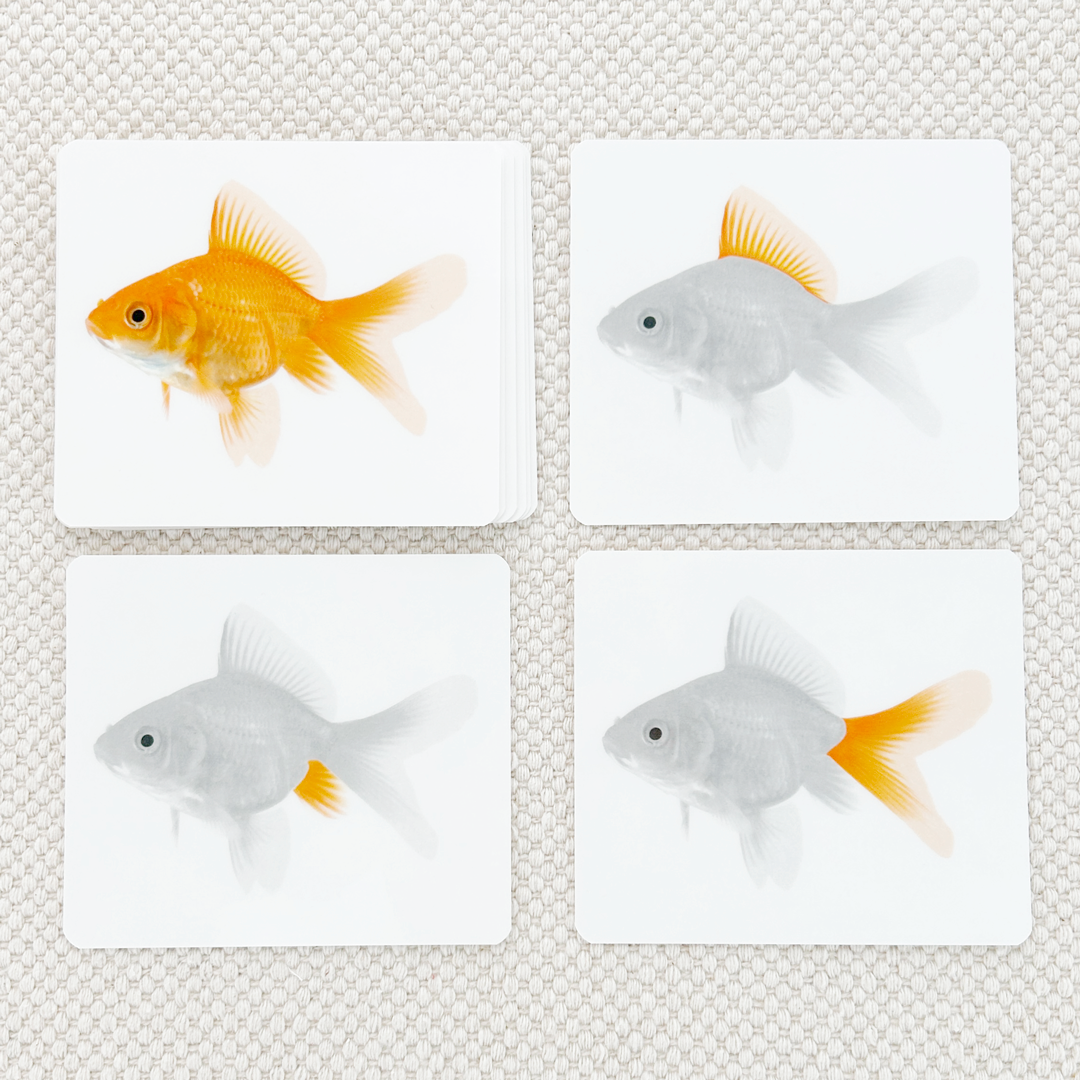
Our Parts of the Fish Vocabulary Cards show real photographs of a goldfish and its key external parts, one card for the whole fish and one for each part. The cards have no text, so pre-readers can focus on each part while learning its name. In each photo, the featured part is shown in full color while the rest of the fish fades to gray, so students can see exactly which part they are naming.
Use these for three-period lessons or for pointing out the same parts on real fish in a classroom aquarium or pond. They are also part of our Parts of the Fish Book & Card Set, an interactive build-a-book reading comprehension activity.
A fish's lateral lines are rows of sense organs along each side of its body that detect movement and vibrations in the water around it. Once students are reading, use the corresponding Parts of the Fish 3-Part Reading Cards to carry the same vocabulary into reading activities.
All five of our vertebrate "Parts of" vocabulary packets (bird, fish, frog, horse, and turtle) isolate the same key parts of each animal, so students can compare them side by side. A fish's pectoral fins, for example, are its front limbs, just like a frog's forelegs, and its pelvic fins match a frog's hind legs. This parallel construction across species indirectly lays the groundwork for later studies of evolution. Collect all five with our Vertebrates "Parts of" Vocabulary Card Set.
What's included
- 13 cards, each showing one real photograph of the whole fish or one of its key external parts, with no text (see photo for list)
- Cards are approx. 4¼" x 3¾"
- Eco-laminated with a food-grade laminate and rounded corners
- Sturdy, clear reclosable bag for storage
- Lesson plan included
Add on our medium cloth pouches for an elegant, child-accessible display solution.
Created by a Montessori teacher and a zoologist. Eco-printed in our rural New England office.
Made in the USA. CPSIA compliant.
Note: Photos may change from those pictured.
Why do vocabulary cards matter for reading?
Interest drives learning. Students who are interested in fish will choose these cards again and again. Each time is more practice naming and discussing. That practice builds vocabulary, part of the language comprehension side of reading in both Gough and Tunmer's (1986) simple view of reading and Scarborough's (2001) reading rope.
How do you use Parts of the Fish Vocabulary Cards?
First, have natural conversations about the fish you’ve seen in an aquarium, a pond, or at the market, and read books about fish. Then use the three-period lesson to teach a few cards at a time, starting with the whole fish. When students are reading, move on to the 3-Part Reading Cards, Parts of the Fish Book, and Definition Cards for a complete learning experience.
What ages is this for?
Typically ages 4 and up. The text-free format works for pre-readers and readers alike, and the cards also support English learners and older students beginning a fish study.
A Note to Teachers
Choose options
Knowledge Bank
Recommended Articles

Download a PDF of our materials

Follow Us